Advertisements
Advertisements
प्रश्न
Views :
Develop a paragraph on the view by using the points given below :
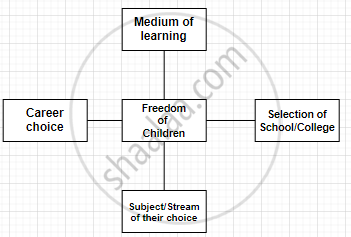
Advertisements
उत्तर
answer is not available.
APPEARS IN
संबंधित प्रश्न
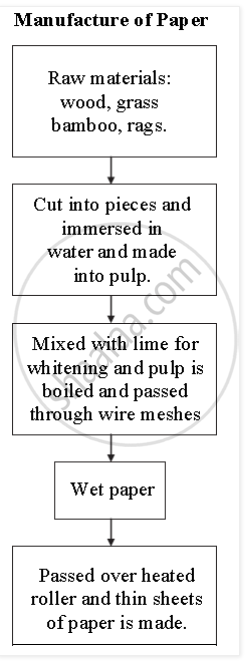
A1. Information Transfer (Non-verbal to verbal)
'Transfer the following information into a paragraph form.
Manuscripts collected from both students and teachers.
↓
Throughly screened, necessary additions, alterations. omissions are made.
↓
Preparing a rough draft
↓
Manuscripts along with a dummy sent to the printer
↓
Proof correction
↓
Sent for final printing
OR
A2. Here are some tips about keeping healthy as given in a Science magazine. Read and
write in the form of Do's and Don'ts (table):
You must include vegetables and fruits in your diet and drink a lot of water. You should avoid junk food and aerated water. You shouldn't sit for long period of time. Rather you should exercise regularly. You shouldn't ignore the importance of good breathing habits. Try breathing deeply whenever you think of it. See to it that you leep for at least 7 hour a day. In fact, you should avoid irregular timings.
|
Courses
|
Intake capacity
|
Vacant seats
|
|
Engineering:
|
||
|
Degree
|
1, 55, 102
|
42, 497
|
|
Diploma
|
1, 65, 413
|
55, 107
|
|
Post - graduation
|
13, 651
|
1, 810
|
|
Pharmacy:
|
||
|
Degree
|
9, 712
|
924
|
|
Diploma
|
12, 959
|
1, 771
|
|
Post - graduation
|
5, 296
|
3, 506
|
Information Transfer (Non-verbal to Verbal):
Read the following paragraph and transfer the information in the form of a tree diagram:
The United Nations was established at the end of the second world war to maintain international peace and security.
In the central system of the UN, there are 15 members of the Security Council. The Economic and Social Council has 54 members. The Secretariat of the United Nations is headed by Secretary-General.
The UN has several specialized agencies such as the World Health Organisation (WHO), the Food and Agricultural Organisation (FAO), the International Labour Organization (ILO), the United Nations Educational, Scientific and Cultural Organisation (UNESCO).
Non-verbal to Verbal:
Transfer the information into a paragraph:
Observe the tree diagram of types of disease and write a paragraph on it. Suggest a suitable title.

Verbal to Non-verbal:
Prepare a fact file using the following points:
Location, Modes of transport, Best time to visit, Accommodation, Places to visit Uniqueness
Ooty or Udhagamandalam’ is a hill station in Tamil Nadu. The queen of the blue mountains sits in the central region of the Nilgiri Range at 7,400 feet, 292 km south west of Bengaluru. The botanical garden, The Ooty Lake, Holy Trinity Church are the places which add to the beauty of Ooty. Wenlock downs is one of the most popular picnic spots in Ooty. Ooty’s hotels range from swanky to budget places. Hotel Surya, Nilgiri Hotel, Khims are some renowned hotels. It is best to visit the place during off season, i.e. March to May to avoid large crowd. Coimbatore is the nearest airport and from there cabs are available to Ooty. From Coimbatore to Udhagamandalam station you may travel by rail or meter gauge. For those taking the road NH 17 Bandipur via Maddur and Mysore will be convenient. From Bandlpur take the route to Mudumalai reserve to Ooty via Gudalur. Ooty is well known for its handmade chocolates, aromatic oils, spices and of course tea.
Non-verbal to verbal
Read the information from the given bar graph and write it in paragraph form.
Non-Verbal to Verbal:
Write the given information in the form of a paragraph:
Distribution of working children by type of work in 2011
| Area of work | Percentage | Number (in millions) |
| Cultivators | 26.0 | 2.63 |
| Agricultural labourers | 32.9 | 3.33 |
| Household workers | 5.2 | 0.52 |
| Other workers | 35.8 | 3.62 |
Verbal to Non-verbal:
Read the following statements and prepare a chart of ‘Dos’ and ‘Don'ts’. Suggest a suitable title for it.
Nature is abode for all of us. It provides us with all our basic needs. However, we must take care of the following things so that our mother nature is not harmed.
- We must plant more trees.
- We should not cut trees.
- We must keep our area neat and clean.
- We should never discharge garbage without proper management.
- We should not pollute air and water.
- We should not use plastic bags.
- We should not hunt birds or animals.
- We should use more of public transport.
- We should spread awareness about the importance of maintaining balance in nature.
Given below is a web diagram containing information about the different means of electronic devices of entertainment-some audio, some visual and some audio-visual.
Write a short paragraph based on information from the web. Give a suitable title to it.

