Advertisements
Advertisements
प्रश्न
Describe the electrolytic refining of copper with the help of a neat labelled diagram.
Advertisements
उत्तर
Electrolytic refinement of copper involves an electrolytic tank with an electrolyte composed of acidified copper sulphate (CuSO4 + dilute H2SO4) solution. An impure copper block is used as an anode by connecting it to the positive terminal of a power supply (battery). A slender strip of exceptionally pure copper serves as the cathode of the cell. The negative terminal of the power supply is linked to it.
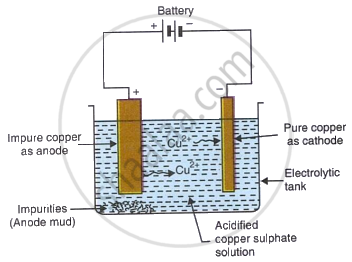
A minor electric current is transmitted across the cell. Atoms from the anode migrate into the electrolyte. The copper from the anode is transformed into copper sulphide. An equivalent quantity of copper atoms from the solution is deposited onto the cathode. This is to maintain a steady concentration of the solution. Impurities from the anode block either persist in the solution or accumulate beneath the anode, as they cannot displace copper from the sulphate solution. The insoluble contaminants that persist in the electrolyte are referred to as anode mud. The copper sulphate solution comprises Cu2+ and \[\ce{SO^{2-}_4}\] ions. The following reactions take place at the anode and cathode when an electric current is passed.
At cathode: \[\ce{\underset{(From electrolyte)}{\underset{Copper ion}{Cu^{2+}}} + \underset{(From cathode)}{\underset{Electrons}{2e-}} -> \underset{(Deposits on cathode)}{\underset{Copper atom}{Cu}}}\]
At anode: \[\ce{\underset{(From impure anode)}{\underset{Copper atom}{Cu}} - \underset{(Given to anode)}{\underset{Electrons}{2e-}} -> \underset{(Goes into electrolyte)}{\underset{Copper ion}{Cu^{2+}}}}\]
Pure copper is extracted from the cathode. The anode thins as the electrolysis proceeds. Significant metals such as gold and silver are found in the anode mud. These may be retrieved individually.
