Advertisements
Advertisements
प्रश्न
Describe briefly using a diagram how sunlight is polarised ?
Advertisements
उत्तर
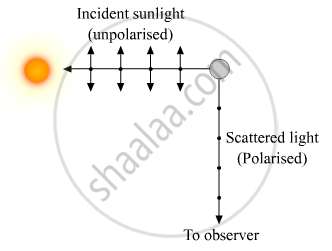
The incident sunlight is unpolarised. The dot and double arrows show the polarization in the perpendicular and in the plane of the figure. Under the influence of the electric field of the incident wave, the electrons in the molecules of the atmosphere acquire components of motion in both these directions. An observer looking at 90° to the direction of the sun, the charges accelerating parallel to the double arrows do not radiate energy towards this observer since their acceleration has no transverse component. The radiation scattered by the molecule is therefore represented by dots. It is linearly polarized perpendicular to the plane of the figure.
APPEARS IN
संबंधित प्रश्न
Show with the help of a diagram, how unpolarised light from Sun gets linearly polarised by scattering.
In the meterbridge experimental set up, shown in the figure, the null point ‘D’ is obtained at a distance of 40 cm from end A of the meterbridge wire. If a resistance of 10Ω is connected in series with R1, null point is obtained at AD = 60 cm. Calculate the values of R1 and R2.
A parallel beam of light is incident on a converging lens parallel to its principal axis. As one moves away from the lens on the other side on its principal axis, the intensity of light
A convex lens is made of a material having refractive index
\[1 \cdot 2\] Both the surfaces of the lens are convex. If it is dipped into water (μ = 1.33), it will behave like
A concave mirror has a focal length of 20 cm. Find the position or positions of an object for which the image-size is double of the object-size.
k transparent slabs are arranged one over another. The refractive indices of the slabs are μ1, μ2, μ3, ... μk and the thicknesses are t1 t2, t3, ... tk. An object is seen through this combination with nearly perpendicular light. Find the equivalent refractive index of the system which will allow the image to be formed at the same place.
A point source is placed at a depth h below the surface of water (refractive index = μ). (a) Show that light escapes through a circular area on the water surface with its centre directly above the point source. (b) Find the angle subtended by a radius of the area on the source.
A paperweight in the form of a hemisphere of radius 3.0 cm is used to hold down a printed page. An observer looks at the page vertically through the paperweight. At what height above the page will the printed letters near the centre appear to the observer?
Explain: ‘How is a rainbow formed’?
Answer the following question in detail.
Explain the formation of a secondary rainbow. For which angular range with the horizontal is it visible?
