Advertisements
Advertisements
प्रश्न
Derive the lens maker’s formula.
Advertisements
उत्तर
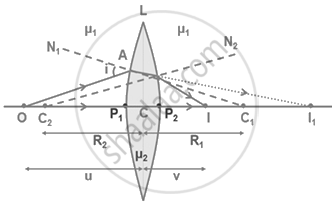
For refraction at LP1N,
`mu_1/(CO) + mu_2/(CI_1) = (mu_2 - mu_1)/(C C_1)`
As if the image is formed in the denser medium.
For refraction at LP2N
`mu_2/(- CI_1) + mu_1/(CI) = (mu_2 - mu_1)/(C C_2)`
As if the object is in the denser medium and the image is formed in the rarer medium.
Combining the refractions at both the surfaces.
`mu_1/(CO) + mu_2/(CI) = mu_2 - mu_1 (1/(C C_1) + 1/(C C_2))`
Substituting the values with sign conventions,
`1/-u + 1/v = (mu_2 - mu_1)/mu_1 (1/R_1 - 1/R_2)`
Since `mu_2/mu_1` = µ
`1/-u + 1/v = (mu_2 - mu_1)/mu_1 (1/R_1 - 1/R_2)`
OR
`1/-u + 1/v = (mu - 1) (1/R_1 - 1/R_2)`
When the object is kept at infinity, the image is formed at the principal focus.
i.e., u = −∞, v = +f
`1/f = (mu - 1) (1/R_1 - 1/R_2)`
This equation is called ‘Lens Maker’s Formula’.
