Advertisements
Advertisements
प्रश्न
(a) Derive an expression for the electric field E due to a dipole of length '2a' at a point distant r from the centre of the dipole on the axial line.
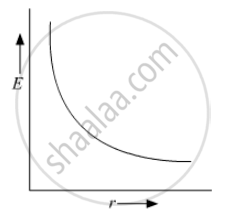
(b) Draw a graph of E versus r for r >> a.
(c) If this dipole were kept in a uniform external electric field E0, diagrammatically represent the position of the dipole in stable and unstable equilibrium and write the expressions for the torque acting on the dipole in both the cases.
Advertisements
उत्तर
(a) Electric Field on Axial Line of an Electric Dipole:
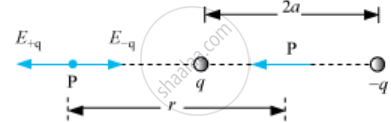
Let P be at distance r from the centre of the dipole on the side of charge q. Then,
`E_(-q)=q/(4piepsilon_0(r+a)^2)hatp`
Where, `hatp` is the unit vector along the dipole axis (from − q to q). Also,
`E_(+q)=q/(4piepsilon_0(r-a)^2)hatp`
The total field at P is
`E=E_(+q)+E_(-q)=q/(4piepsilon_0)[1/(r-a)^2-1/(r+a)^2]hatp`
`E=q/(4piepsilon_0)(4ar)/(r^2-a^2)^2hatp`
for r >> a
`E=(4qa)/(4piepsilon_0r^3)hatp` (r >> a)
`E=(2p)/(4piepsilon_0r^3)` `[because vecp=qxxvec(2a)hatp]`
(b) For r >> a, `E prop 1/r^3`
(c) Position of dipole in stable equilibrium: In stable equilibrium, dipole aligns itself in the direction of external electric field.
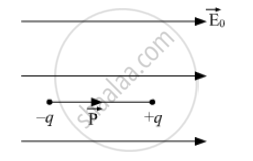
Therefore, angle (θ) between `vecP` and `vecE_0` is 0 and we know torque acting on the dipole in an external field is given by the expression
τ = PEsinθ
As, θ is 0° for stable equilibrium
Therefore, τ = PEsinθ
τ= PEsin0°
τ = 0
Position of dipole in unstable equilibrium: In unstable equilibrium, dipole aligns itself in the direction opposite to the direction of external electric field.
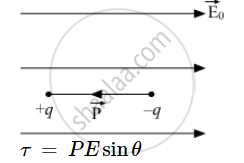
τ = PEsinθ
As, θ is 180° for unstable equilibrium
Therefore, τ = PEsinθ
τ= PEsin180°
τ = 0
