Advertisements
Advertisements
प्रश्न
Advertisements
उत्तर
APPEARS IN
संबंधित प्रश्न
Define one pascal (Pa), the S.I. unit of pressure.
Explain the principle of a hydraulic machine. Name two devices which work on this principle.
What should be the ratio of area of cross section of the master cylinder and wheel cylinder of a hydraulic brake so that a force of 15 N can be obtained at each of its brake shoe by exerting a force of 0.5 N on the pedal ?
The areas of pistons in a hydraulic machine are 5 cm2 and 625 cm2. What force on the smaller piston will support a load of 1250 N on the larger piston? State any assumption which you make in your calculation.
The atmospheric pressure at a place is 650 mm of Hg. Calculate this pressure in Pascals (Pa).
How does the liquid pressure on a diver change according to the following condition:
When the driver moves horizontally
Hydraulic lift works under the principle of _______.
Match the following:
| 1. | Hydraulic press | a. | Archimedes |
| 2. | Cartesian Diver | b. | Floatation |
| 3. | Hydrostatic Balance | c. | Pascal’s law |
| 4. | Hydrometer | d. | Buoyancy |
Consider a water tank shown in the figure. It has one wall at x = L and can be taken to be very wide in the z direction. When filled with a liquid of surface tension S and density ρ, the liquid surface makes angle θ(θ << 1) with the x-axis at x = L. If y(x) is the height of the surface then the equation for y(x) is:
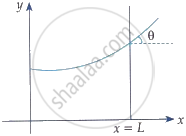
(take θ(x) = sin θ(x) = tan θ(x) = `dy/dx`, g is the acceleration due to gravity)
