Advertisements
Advertisements
प्रश्न
Deduce the expression for the magnetic field at a point on the axis of a current carrying circular loop of radius ‘R’ distant ‘x’ from the centre. Hence, write the magnetic field at the centre of a loop.
Advertisements
उत्तर
dB∝ `(IDlxxr)/r^3`
`dB =mu_0/(4pi) (Idlxxr)/r^3`
Here, `mu_0/(4pi)`is a constant of proportionality.
The magnitude of this field is given as
`|dB|=mu_0/(4pi) (Idlsintheta)/r^2`
Magnetic field on the axis of a circular current loop:
Consider a circular loop carrying a steady current I. The loop is placed in the y–z plane
with its centre at origin O and has a radius R.
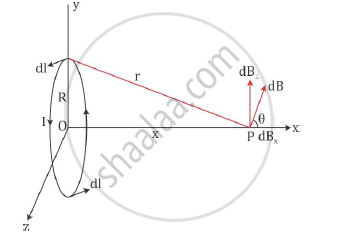
Let x be the distance of point P from the centre of the loop where the magnetic field is to
be calculated. Consider a conducting element dl of the loop. The magnitude dB of the
magnetic field due to dl is given by the Biot–Savart’s law as
`dB=mu_0/(4pi) (I|dlxxr|)/r^3`
From the figure, we see that r2 = x2 + R2.
Any element of the loop will be perpendicular to the displacement vector from the element to the axial point. Hence, we have `|dlxxr|=rdl` Thus, we have
`dB=mu_0/(4pi) (Idl)/r^2=mu_0/(4pi) (Idl)/(x^2+R^2) ".....(1)"`
The direction of dB is perpendicular to the plane formed by dl and r. It has an xcomponent
dBx and a component perpendicular to x-axis dB⊥
The perpendicular components cancel each other when summed over. Therefore, only the x component contributes. The net contribution is obtained by integrating dBx = dB cosθ
From the figure, we see that
`costheta=R/r=R/sqrt(x^2+R^2) "...(2)"`
From equations (1) and (2), we get
`dB_x=dBcostheta=mu_0/(4pi) (Idl)/(x^2+R^2)xxR/sqrt(x^2+R^2)=(mu_0Idl)/(4pi)xxR/(x^2+R^2)^(3/2)`
The summation of dl yields circumference of the loop 2πR. Hence, the magnetic field at
point P caused by the entire loop is
`B=B_xhati=(mu_0I(2piR))/(4pi)xxR/(x^2+R^2)^(3/2)hati`
`B=(mu_0IR^2)/(2(x^2+R^2)^(3/2))hati`
Case: At the centre of the loop
At the centre x = o, so we have
`B=(mu_0IR^2)/(2(R^2)^(3/2))hati=(mu_0IR^2)/(2R^3)hati=(mu_0I)/(2R)hati`
