Advertisements
Advertisements
प्रश्न
Copy the Fig. I and Fig. II. Both Figures show isosceles right angled glass prisms.
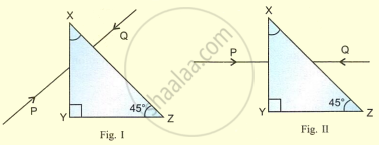
- Trace the course of rays P and Q till the rays emerge out in (i) Fig. I, (ii) Fig. II.
- Which ray gets only refracted in (i) Fig. I and (ii) Fig. II?
- Which ray gets totally internally reflected in (i) Fig. I and (ii) Fig. II?
- Which surface appears silvery in (i) Fig. I and (ii) Fig. II?
सविस्तर उत्तर
Advertisements
उत्तर
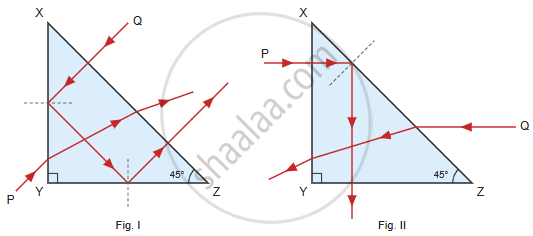
(a) Course of rays
- Fig. I:
- Ray Q falls normally on XZ and enters without bending.
- Q strikes XY at 45°, is totally internally reflected, then strikes YZ at 45° and is totally reflected again.
- Q then leaves XZ normally, turned through 180°.
- Ray P is refracted towards the normal at XY, then refracted away from the normal at XZ, and emerges.
- Fig. II:
- Ray P falls normally on XY and enters without bending.
- P strikes XZ at 45°, is totally internally reflected, and leaves YZ normally, turned through 90°.
- Ray Q is refracted at XZ, then refracted again at XY, and emerges.
(b)
- Fig. I: ray P
- Fig. II: ray Q
(c)
- Fig. I: ray Q
- Fig. II: ray P
(d)
- Fig. I: faces XY and YZ.
- Fig. II: face XZ.
A surface where total internal reflection takes place looks silvery.
shaalaa.com
या प्रश्नात किंवा उत्तरात काही त्रुटी आहे का?
