Advertisements
Advertisements
प्रश्न
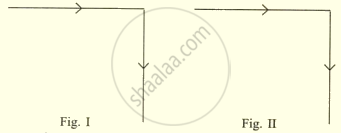
- Copy the Figs. I and II. By using a suitable apparatus show rays of light in Fig. I and Fig. II can be turned through 90° by two different ways.
- Also, state in which of the two cases light is not absorbed and why?
सविस्तर उत्तर
Advertisements
उत्तर
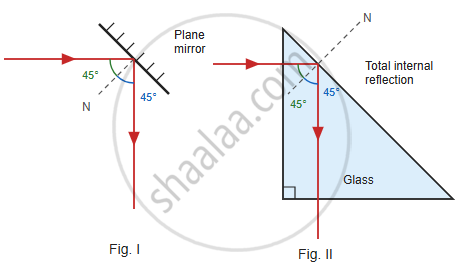
(a)
- Fig. I: A plane mirror is placed at 45° to the incident ray. The ray strikes the mirror at an angle of incidence of 45° and reflects at 45°, so it turns through 90°.
- Fig. II: A right-angled isosceles glass prism is used. The ray enters one face of the prism normally and strikes the hypotenuse at 45°. Since 45° is greater than the critical angle of glass (42°), the ray is totally internally reflected. It leaves through the other face normally, turned through 90°.
(b) Light is not absorbed in Fig. II (the prism). Total internal reflection reflects 100% of the light, so no light is lost. A plane mirror absorbs some of the light falling on it, so the reflected light is fainter.
shaalaa.com
या प्रश्नात किंवा उत्तरात काही त्रुटी आहे का?
