Advertisements
Advertisements
प्रश्न
Construction of ray diagrams.
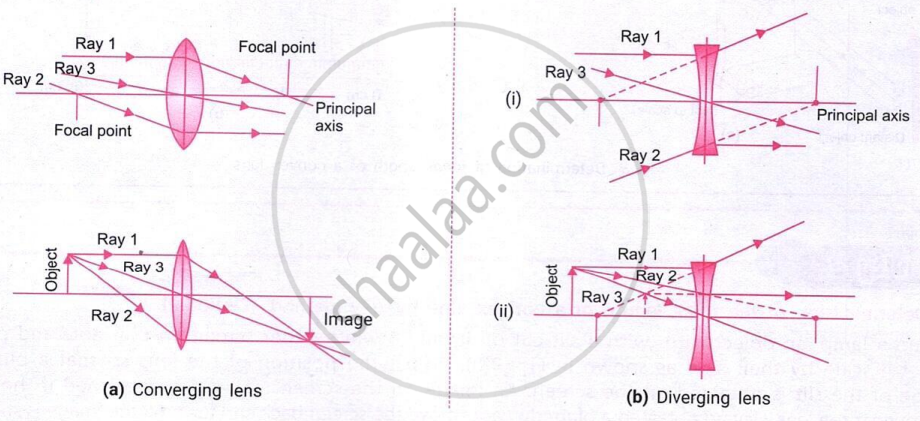
Three types of rays are considered for construction of ray diagrams. The behaviours of three types of rays, when they pass through the lens, which are used to locate the image formed by a converging lens and a diverging lens in geometrical construction, is illustrated in Fig.
The behaviours of three types of rays when they pass through the converging lens is as follows:
- The incident ray parallel to the principal axis passes through the focal point after refraction.
- The incident ray passing through the focal point becomes parallel to the principal axis after refraction.
- The incident ray passing through the optical centre \(O\) is not deviated after refraction.
Steps for the Geometrical Construction
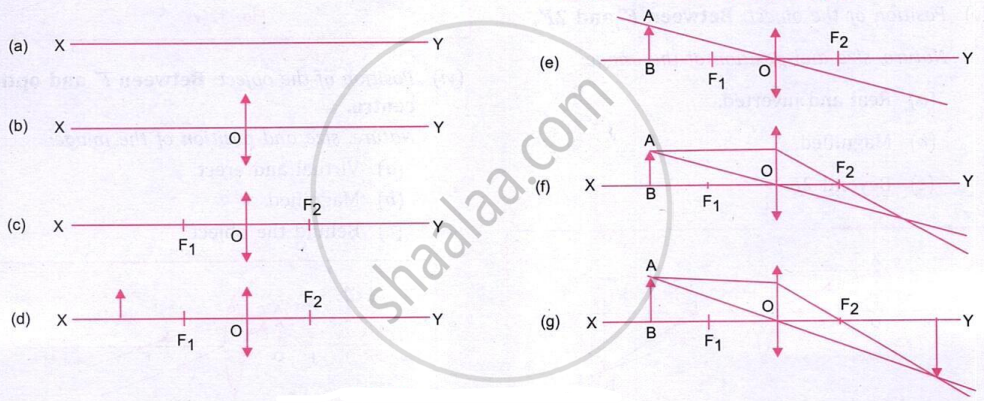
- Draw a line \(X Y\) on the paper to represent the principal axis [Fig. (a)].
- Mark the position of the lens by a vertical line drawn across the principal axis at \(O\) [Fig. (b)].
- Mark the two principal foci \(F_{2}, F_{1}\) equidistant from \(O\) [Fig. (c)].
- Draw an object \(A B\) [Fig. (d)].
- Draw one ray from the top of the object \(A B\) through the optical centre [Fig. (e)].
- Draw a second ray from the top of the object parallel to the axis \(X Y\). This ray is bent and passes through \(F_{2}\) [Fig. (f)].
- The image of the top of the object is at the point where these two rays meet. Draw the image at that point [Fig. (g)].
Advertisements
उत्तर
The behaviour of three principal rays when passing through a converging (convex) and diverging (concave) lens is summarized below:
| Ray Description | Behaviour in Converging Lens (Convex) | Behaviour in Diverging Lens (Concave) |
|---|---|---|
| Ray parallel to principal axis | Refracts and passes through the second focal point \(F_2\). | Refracts and appears to diverge from the first focal point \(F_1\). |
| Ray passing through (or directed towards) the focal point | Refracts and emerges parallel to the principal axis. | Refracts and emerges parallel to the principal axis (if incident directed towards \(F_2\)). |
| Ray passing through the optical centre (O) | Passes straight through without deviation. | Passes straight through without deviation. |
1. For a Converging Lens:
- Parallel Ray: An incident ray parallel to the principal axis passes through the focal point \(F_2\) after refraction. \[ \text{Ray} \parallel \text{Axis} \rightarrow \text{Passes through } F_2 \]
- Focal Ray: An incident ray passing through the first focal point \(F_1\) becomes parallel to the principal axis after refraction. \[ \text{Ray through } F_1 \rightarrow \text{Ray} \parallel \text{Axis} \]
- Centre Ray: An incident ray passing through the optical centre (O) continues in a straight line. \[ \text{Ray through } O \rightarrow \text{No Deviation}\]
2. Steps for Geometrical Construction (Convex Lens)
- Draw Principal Axis: Draw a horizontal line (XY).
- Mark Lens: Draw a vertical line representing the lens crossing (XY) at the optical centre (O).
- Mark Foci: Mark \(F_1\) and \(F_2\) equidistant from (O). Usually, \(2F_1\) and \(2F_2\) are also marked.
- Draw Object: Draw the object (AB) vertically perpendicular to the principal axis. (B) is on the axis, (A) is the top.
- Ray 1 (Through Centre): Draw a line from the top of the object (A) through (O).
- Ray 2 (Parallel Ray): Draw a line from (A) parallel to (XY). From the lens, draw the refracted ray passing through \(F_2\).
- Locate Image: The point where Ray 1 and Ray 2 intersect is the top of the image (A'). Draw (A'B') perpendicular to the axis.
Visual Representation:
- Object: (AB)
- Image: (A'B') (Real, Inverted, Diminished - in this specific example shown in Fig)
Observation: The image formed is on the opposite side of the lens, inverted, and smaller than the object, indicating the object was placed beyond \(2F_1\).
