Advertisements
Advertisements
प्रश्न
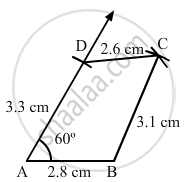
Construct a quadrilateral ABCD in which AB = 2.8 cm, BC = 3.1 cm, CD = 2.6 cm, and DA = 3.3 cm and ∠A = 60°.
Advertisements
उत्तर
Steps of construction:
Step I: Draw AB = 2 . 8 cm .
Step II: Construct ∠BAD = 60° .
Step III : With A as the centre and radius 3 . 3 cm, cut off AD = 3 . 3 cm .
Step IV: With D as the centre and radius 2 . 6 cm, draw an arc .
Step V : With B as the centre and radius 3 . 1 cm, draw an arc to intersect the arc drawn in Step IV at C .
Step VI: Join BC and CD to obtained the required quadrilateral .
संबंधित प्रश्न
Construct a quadrilateral ABCD in which AB = 3.8 cm, BC = 3.0 cm, AD = 2.3 cm, AC = 4.5 cm and BD = 3.8 cm.
Construct a quadrilateral ABCD in which AB = 7.7 cm, BC = 6.8 cm, CD = 5.1 cm, AD = 3.6 cm and ∠C = 120°.
Construct a quadrilateral ABCD in which AB = BC = 3 cm, AD = CD = 5 cm, and ∠B = 120°.
Construct a quadrilateral ABCD in which AB = BC = 6 cm, AD = DC = 4.5 cm and ∠B = 120°.
Construct a quadrilateral PQRS, in which ∠Q = 45°, ∠R = 90°, QR = 5 cm, PQ = 9 cm and Rs = 7 cm.
Construct a quadrilateral ABCD given that AB = 4 cm, BC = 3 cm, ∠A = 75°, ∠B = 80° and ∠C = 120°.
Construct the following quadrilaterals with the given measurements and also find their area.
AGRI, AG = 4.5 cm, GR = 3.8 cm, ∠A = 60°, ∠G = 110° and ∠R = 90°
In a parallelogram PQRS, if ∠P = 60°, then other three angles are ______.
A quadrilateral can be constructed uniquely if three angles and any two sides are given.
Is it possible to construct a quadrilateral ROAM in which RO = 4 cm, OA = 5 cm, ∠O = 120°, ∠R = 105° and ∠A = 135°? If not, why?
