Advertisements
Advertisements
प्रश्न
Construct a quadrilateral ABCD, when AB = 6 cm, BC = 5.5 cm, CD = 4.1 cm, ∠A = 120°, ∠B = 45°
भौमितिक रेखाचित्रे
Advertisements
उत्तर
Given:
- AB = 6 cm
- BC = 5.5 cm
- CD = 4.1 cm
- ∠A = 120°
- ∠B = 45°
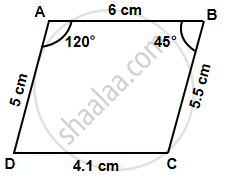
Steps of construction:
- Draw the line segment AB = 6 cm.
- At point A, construct an angle of 120° using a protractor.
- At point B, construct an angle of 45° using a protractor.
- From B, draw a ray BC making the 45° angle with AB and cut off BC = 5.5 cm on this ray.
- Connect C.
- Using compass and ruler, locate point D such that CD = 4.1 cm and D lies at such a position that the quadrilateral ABCD is closed.
- To do this, draw an arc of radius 4.1 cm from C.
- From point A, draw an arc with a suitable radius derived from construction steps to intersect the previous arc.
- The intersection point is D.
- Join AD and CD to complete quadrilateral ABCD.
ABCD is the quadrilateral with sides AB = 6 cm, BC = 5.5 cm, CD = 4.1 cm and angles ∠A = 120°, ∠B = 45° constructed as per the steps above.
shaalaa.com
या प्रश्नात किंवा उत्तरात काही त्रुटी आहे का?
पाठ 12: Rectilinear Figures (Theorems on Parallelograms and Construction of Polygons) - EXERCISE 12B [पृष्ठ १४९]
