Advertisements
Advertisements
प्रश्न
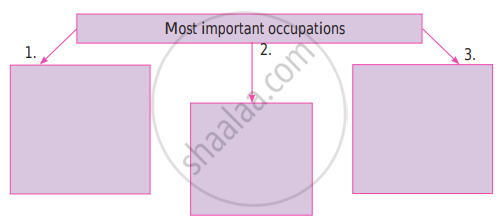
Complete the Tree diagram associated with the happenings in the story.
Advertisements
उत्तर
Most important occupations
1 science
2 skill in warfare
3 religious worship
APPEARS IN
संबंधित प्रश्न
Expressions in English classified under different heads. Pair up with your partner, guess, and match the columns. (Use a dictionary.)
| A | B | |
| (1) Principle | (a) | a generally accepted, evident, truth |
| (2) Quotation | (b) | short striking messages for the public |
| (3) Moral | (c) | a short witty remark stating the truth |
| (4) Idioms | (d) | a popular, well-known truth |
| (5) Slogans | (e) | established expressions which do not convey exactly the same as individual words |
| (6) One-liners | (f) | words cited from a speech/text of a famous person |
| (7) Maxims | (g) | a lesson derived from a story or experience |
| (8) Proverb | (h) | a rule to govern one’s behaviour |
Read the polite request/suggestion and complete the gaps in the responses. Make sure they are polite and not repeated.
| Is it alright if I use your laptop? | Accept (1) ____________ Refuse (2) ____________ |
Write down in your notebook two points for the following. How do you know?
the hermit was truly wise.
Choose the correct answer and fill in the blank.
“Varied” (Paragraph-3) means ______________.
Choose the correct answer and fill in the blank.
The King wanted to know the ________ time to begin everything.
Choose the correct answer and fill in the blank.
‘‘I pray you to answer my question.’’ Here ‘pray’ means _______________.
Answer the following question.
The hermit ‘spoke only to common people’; so the king ‘put on simple clothes’. Do you think the king hoped to be mistaken for a common man or was he just showing that he was a humble person? What shows that the hermit knew him to be the king?
Answer the following question.
Did the king behave as an ordinary person, rather than as a ruler, at the hermit’s hut? What shows it? Did he also act as a good, kind person? When did he do so?
Answer the following question.
Do you think the hermit knew, beforehand, not only about the king’s arrival but about the ambush by his enemy? Think a little about this and say what you really feel.
Read the following passage and do the activities:
(A1) Relate the following actions with the king and the hermit: (2)
| digging | learning things | breathe heavily | asking questions |
| King | Hermit |
| 1.______ | 1.______ |
| 2.______ | 2.______ |
|
When the king arrived, the hermit was digging the ground in front of his hut. He greeted the king but went on digging. The hermit was frail and weak, and each time he struck the ground with the spade and turned over a little earth, he breathed heavily. The king went up to him and said, “I have come to you, wise hermit, to ask you to answer three questions - How can I learn to do the right thing at the right time? Who are the people I most need, and to whom should I, therefore, pay most attention? And what affairs are the most important and need my first attention?” The hermit listened to the king but said nothing. He just spat on his hand and resumed digging. The king watched in silence for a while. Then, feeling sorry for the hermit, he said, “You are tired, let me take the spade and work awhile for you.” The hermit silently handed over the spade and sat down on the ground. When he had dug two beds, the king stopped and repeated his questions. |
(A2) State whether you agree/disagree with the following statements: (2)
- The hermit was strong and agile.
- The king came to the hermit to ask three questions.
- The hermit handed over the spade and sat down.
- The king wasn’t feeling sorry for the hermit.
(A3) Solve the cross word puzzle using words from the passage referring to the clues are given: (2)
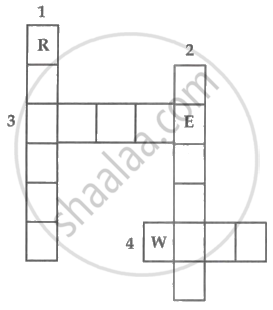
| Down | Across |
| (1) Restart/Start again | (3) A tool for digging |
| (2) Sage |
(4) Intelligent |
(A4) Do as Directed: (2)
- When the king arrived the hermit was digging the ground.
(Name and identify the subordinate clause.) - The hermit listened to the king but said nothing.
(Rewrite the sentence and begin it with “Though …...)
(A5) Whom do you consider your guide when you are in difficulty? Why? (2)
