Advertisements
Advertisements
प्रश्न
Classify the things below.
| Sl. No | Examples | Class of Lever |
| 1. | Spade | |
| 2. | Seesaw | |
| 3. | Wheel barrow | |
| 4. | Plier | |
| 5. | Nail cutter |
Advertisements
उत्तर
| Sl. No | Examples | Class of Lever |
| 1. | Spade | Class III lever |
| 2. | Seesaw | Class I lever |
| 3. | Wheel barrow | Class II lever |
| 4. | Plier | Class I lever |
| 5. | Nail cutter | Class I lever |
APPEARS IN
संबंधित प्रश्न
Name the class to which the following lever belong:
a nutcracker
Name the class to which the following lever belong:
a wheelbarrow
Draw diagram to illustrate the position of fulcrum, load, and effort, of the following:
a see-saw.
How does the friction at the fulcrum affect the mechanical advantage of the lever?
Answer the following in a word or two or in a sentence.
Give one example of a machine used to multiply speed.
Name the three classes of levers and state how are they distinguished. Give two examples of each class.
Explain why the mechanical advantage of a class II of lever is always more than 1.
Classify the following into levers:
A catapult
Classify the following into levers:
A fishing rod
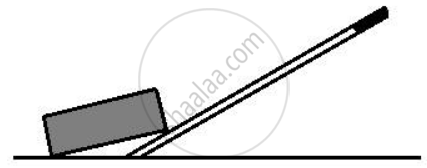
The diagram below shows a rod lifting a stone.
- Mark position of fulcrum F and draw arrows to show the directions of load L and effort E.
- What class of lever is the rod?
- Give one more example of the same class of lever stated in part (b).