Advertisements
Advertisements
प्रश्न
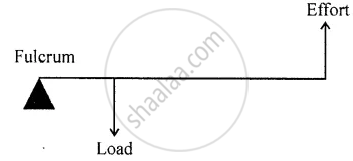
The diagram given below shows the three kinds of levers. Name the class of lever and give one example of the class.
Advertisements
उत्तर
The provided diagram shows a lever system with the fulcrum, load, and effort clearly labeled.
Class of Lever
This is a Class 1 Lever, where the fulcrum is positioned between the load and the effort.
Examples of Class 1 Lever
- Seesaw: A common playground equipment.
- Scissors: Both handles and blades operate as Class 1 levers.
- Crowbar: Used for prying objects.
How It Works:
- In a Class 1 lever, the effort and load move in opposite directions around the fulcrum.
- Depending on the position of the fulcrum, the lever can be used to gain either a mechanical advantage (make lifting easier) or speed advantage.
APPEARS IN
संबंधित प्रश्न
Which class of lever has the mechanical advantage always less than 1? Give an example.
Give one example of a class I lever in a case where the mechanical advantage is equal to 1?
Name the class to which the following lever belong:
an oar rowing a boat.
Name the machine to which the following belong:
Lemon crusher
A lever of length 100 cm has the effort of 15 kgf at a distance of 40 cm from the fulcrum at one end. What load can be applied at its other end?
Answer the following.
What is a Class I lever?
Tick the most appropriate answer.
A pair of scissors is an example of a/an
What is the use of the lever if its mechanical advantage is
- more than 1,
- equal to 1, and
- less than 1?
Draw a labelled diagram of a class II lever. Give one example of such a lever.
Classify the following into levers:
Wheel barrow
