Advertisements
Advertisements
प्रश्न
Categorise the following parts under (i) external, (ii) middle and (iii) internal ear.
Ear drum, hammer, pinna, cochlea, anvil, stirrup, eustachian tube, tympanum, oval window, semi-circular canals.
Advertisements
उत्तर
- External ear: Pinna, Tympanum, Ear drum.
- Middle ear: Hammer, anvil, stirrup, Eustachian tube, oval window.
- Internal ear: Semi-circular canals, Cochlea.
APPEARS IN
संबंधित प्रश्न
Time taken by an object to complete one oscillation is called ___________.
the biological/technical terms for a thin membrane covering the entire front part of the eye.
Give technical terms for The nerve which transmits impulses from the ear to the brain
Sclerotic layer or choroid layer (Which one forms the Iris?)
Name the following:
The tube which connects the cavity of the middle ear with the throat.
State whether the following statements are true (T) or false (F). If false, correct them by changing any one single word in each.
Semi-circular canals are concerned with static (positional) balance.
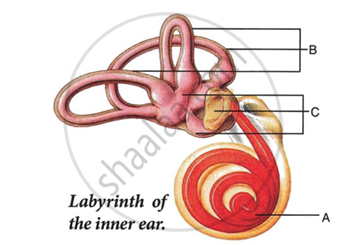
Given below is the diagram of a part of the human ear. Study the same and answer the questions that follow:
 |
Give the collective biological term for Malleus, locus and Stapes.
Draw a neat and labelled diagram of the human ear. With the help of this diagram, explain the construction and working of the human ear.
Write whether the following is true or false:
The part of the ear associated with balance is the cochlea.
The range of audible frequency for the human ear is
