Advertisements
Advertisements
प्रश्न
Can Bernoulli’s equation be used to describe the flow of water through a rapid in a river? Explain.
Advertisements
उत्तर १
No
Bernoulli’s equation cannot be used to describe the flow of water through a rapid in a river because of the turbulent flow of water. This principle can only be applied to a streamline flow
उत्तर २
Bernoulli’s theorem is applicable only for there it ideal fluids in streamlined motion. Since the flow of water in a river is rapid, way cannot be treated as streamlined motion, the theorem cannot be used.
APPEARS IN
संबंधित प्रश्न
Fill in the blanks using the word(s) from the list appended with each statement
For the model of a plane in a wind tunnel, turbulence occurs at a ... speed for turbulence for an actual plane (greater / smaller)
In a test experiment on a model aeroplane in a wind tunnel, the flow speeds on the upper and lower surfaces of the wing are 70 m s–1and 63 m s–1 respectively. What is the lift on the wing if its area is 2.5 m2? Take the density of air to be 1.3 kg m–3.
Figures (a) and (b) refer to the steady flow of a (non-viscous) liquid. Which of the two figures is incorrect? Why?
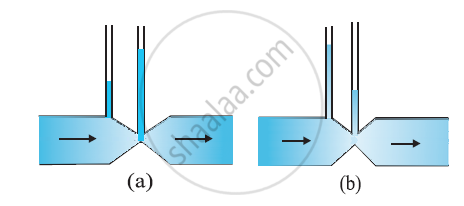
The cylindrical tube of a spray pump has a cross-section of 8.0 cm2 one end of which has 40 fine holes each of diameter 1.0 mm. If the liquid flow inside the tube is 1.5 m min–1, what is the speed of ejection of the liquid through the holes?
A Gipsy car has a canvass top. When the car runs at high speed, the top bulges out. Explain.
Bernoulli's theorem is based on the conservation of
A large cylindrical tank has a hole of area A at its bottom. Water is poured in the tank by a tube of equal cross-sectional area A ejecting water at the speed v.
Suppose the tube in the previous problem is kept vertical with A upward but the other conditions remain the same. the separation between the cross sections at A and B is 15/16 cm. Repeat parts (a), (b) and (c) of the previous problem. Take g = 10 m/s2.
What is the basis of Bernoulli’s principle?
A large number of liquid drops each of radius 'a' are merged to form a single spherical drop of radius 'b'. The energy released in the process is converted into kinetic energy of the big drop formed. The speed of the big drop is [p = density of liquid, T = surface tension of liquid] ____________.
When one end of the capillary is dipped in water, the height of water column is 'h'. The upward force of 119 dyne due to surface tension is balanced by the force due to the weight of water column. The inner circumference of the capillary is (Surface tension of water= 7 x 10⁻² N/m) ____________.
Two wires are made of the same material and have the same volume. However wire 1 has cross-sectional area A and wire 2 has cross-sectional area 9A. If the length of wire 1 increases by Δx on applying force F, how much force is needed to stretch wire 2 by the same amount?
Explain the working of an atomizer.
