Advertisements
Advertisements
प्रश्न
By what number should (–8)–3 be multiplied so that the product may be equal to (–6)–3?
Advertisements
उत्तर
Let x be the number multiplied with (–8)–3 to get the product equal to (–6)–3.
⇒ x × (–8)–3 = (–6)–3
⇒ `x = (-6)^-3/(-8)^-3`
= `(-8)^3/(-6)^3`
= `512/216`
= `64/27`
APPEARS IN
संबंधित प्रश्न
If x be any integer different from zero and m, n be any integers, then (xm)n is equal to ______.
Find the product of the cube of (–2) and the square of (+4).
By what number should `((-3)/2)^-3` be divided so that the quotient may be `(4/27)^-2`?
`(16 xx 10^2 xx 64)/(2^4 xx 4^2)`
For hook-up, determine whether there is a single repeater machine that will do the same work. If so, describe or draw it.
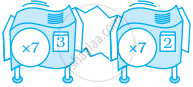
For hook-up, determine whether there is a single repeater machine that will do the same work. If so, describe or draw it.
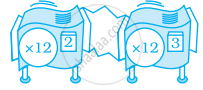
Supply the missing information for diagram.
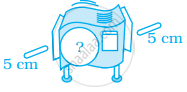
If possible, find a hook-up of prime base number machine that will do the same work as the given stretching machine. Do not use (× 1) machines.

If possible, find a hook-up of prime base number machine that will do the same work as the given stretching machine. Do not use (× 1) machines.

