Advertisements
Advertisements
प्रश्न
Atomic number of metal ‚A‛ is 11, while atomic number of metal ‚B‛ is 20. Which of them will be more reactive? Write the chemical reaction of dilute HCl with metal ‚A‛.
Advertisements
उत्तर
Metal ‘A’ is more reactive than metal ‘B’.
Atomic number of metal ‘A’ is 11, hence it is Na.
`2Na + 2HCI → 2NaCI(aq) + H_2 (g) `
APPEARS IN
संबंधित प्रश्न
Elements in the same group show the same valency. Give scientific reason.
The atomic numbers of three elements A, B and C are 12, 18 and 20 respectively. State, giving reason, which two elements will show similar properties.
An element 'X' belong to 3rd period and group 13 of the Modern Periodic Table.
(a) Determine the valence electrons and the valency of 'X'.
(b) Molecular formula of the compound formed when 'X' reacts with an element 'Y' (atomic number = 8).
(c) Write the name and formula of the compound formed when 'X' combines with chlorine
The elements 4Be, 12Mg and 20Ca, each having two valence electrons in their valence shells, are in periods 2, 3 and 4 respectively of the modern periodic table. Answer the following questions associated with these elements, giving reason in each case:
(a) In which group should they be?
(b) Which one of them is least reactive?
(c) Which one of them has the largest atomic size?
Write the number of vertical columns in the modern periodic table. What are these columns called?
Based on the group valency of elements state the formula lot the following giving justification for each :-
(i) Oxides of 1st group elements,
(ii) Halides of the elements of group 13, and
(iii) Compounds formed when an element of group 2 combines with, an element of group 16.
Which element has a total of two shells, with three electrons in its valence shell?
Classify the following elements into metals, non-metals and metalliods
As, C, Hg, Mg, S, Si
In the following set of element, one element does not belong to the set. Select this element and state why it does not belong:
Calcium, Magnesium, Sodium, Beryllium
What happens to the metallic character of the elements as we go down in a group of the periodic table?
How do electronic configurations of elements change in second period of periodic table with increase in atomic numbers?
The atomic radii of three elements X, Y and Z of a period of the periodic table are 186 pm; 104 pm and 143 pm respectively. Giving a reason, arrange these elements in the increasing order of atomic numbers in the period.
Why do elements in the same group show similar properties but the elements in different groups show different properties?
For each of the following triads, name the element with the characteristics specified below:
| Elements | Least atomic radius | Chemically least reactive |
| (i) F, Cl, Br (ii) Li, Na, K |
.................... .................... |
.................... .................... |
How does the tendency to lose electrons change as we go down in group 1 of the periodic table? Why does it change this way?
The electronic configuration of the atom of an element X is 2, 8, 4. In modern periodic table, the element X is places in :
(a) 2nd group
(b) 4th group
(c) 14th group
(d) 8th group
Given alongside is a part of the periodic table. As we move vertically downward from Li to Fr:
| Li | Be |
| Na | |
| K | |
| Rb | |
| Cs | |
| Fr | Ra |
What happens to their metallic character?
An element which is an essential constituent of all organic compounds belongs to following group of modern periodic table:
(a) group 4
(b) group 14
(c) group 15
(d) group 16
Which of the following set of elements is written correctly in the order of their increasing metallic character?
(a) Mg, Al, Si
(b) C, O, N
(c) Na, Li, K
(d) Be, Mg, Ca
How do the following change on moving from left to right in a period of the periodic table?
Give examples in support of your answer.
atomic structure (electron arrangements) ?
An element X belong to 3rd periods and group II of the periodic table state:
the number of valence electrons,
An element X belong to 3rd periods and group II of the periodic table state:
the valency,
What is the common feature of the electronic configuration of the elements at the end of period 2, and period 3?
Four elements P, Q, R and S belong to the third period of the Modern Periodic Table and have respectively 1, 3, 5 and 7 electrons in their outermost shells. Write the electronic configurations of Q and R and determine their valences. Write the molecular formula of the compound formed when P and S combine.
An element 'M' has atomic number 12.
(a) Write its electronic configuration.
(b) State the group to which 'M' belongs.
(c) Is 'M' a metal or a non-metal.
(d) Write the formula of its chloride.
Calculate the valency of element X whose atomic number is 9.
Study the extract of the Periodic Table given below and answer the questions that follow. Give the alphabet corresponding to the element in question. DO NOT repeat an element. 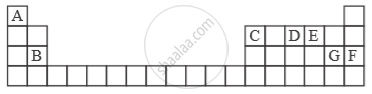
The ion of which element will migrate towards the cathode during electrolysis?
What is meant by periodicity of elements?
Fill in the blank
There are ______ groups and ______ periods in the modern form of periodic table.
Copy and complete the following sentence choosing the correct word or words from those given below, at the end of the sentence:
The similarities in the properties of elements belonging to a group are because they have the same ______
Arrange the following as per instruction given in the bracket.
Li, K, Na, H ( decreasing order of their potential ionisation )
The position of elements A, B, C, D and E in the periodic table are shown below:
|
Group 1 |
Group 2 |
Group 17 |
Group 18 |
|
|
|
|
D |
|
|
B |
C |
|
|
A |
|
|
E |
Which is larger in size (i) D or E (ii) B or C
An element belongs to the third period and Group IIIA (13) of the periodic table. State: the number of valence electrons,
An element belongs to the third period and Group IIIA (13) of the periodic table. State: if it is a metal or non-metal?
Name and state the following with reference to the elements of the first three periods of the periodic table.
Non-metallic elements present in Period 3 of Groups 15 and 16.
The position of certain elements in the Modern Periodic Table is shown below:
| Group → Period ↓ |
1 | 2 | 3 to 12 | 13 | 14 | 15 | 16 | 17 | 18 |
| 1 | G | H | |||||||
| 2 | A | I | B | C | |||||
| 3 | D | E | F |
Using the above table answer the following questions giving reasons in each case:
- Which element will form only covalent compounds?
- Which element is a non-metal with valency 2?
- Which element is a metal with valency 2?
- Out of H, C, and F which has the largest atomic size?
- To which family does H, C, and F belong?
Name the elements in Period 1.
The similarities in the properties of a group of elements are because they have the same ______.
