Advertisements
Advertisements
प्रश्न
Answer the following question in detail.
Obtain the expressions for magnifying power and the length of an astronomical telescope under normal adjustments.
Advertisements
उत्तर
- For telescopes, α is the visual angle of the object from its own position, which is practically at infinity.
- The visual angle of the final image is β and its position can be adjusted to be at D. However, under normal adjustments, the final image is also at infinity making a greater visual angle than that of the object.
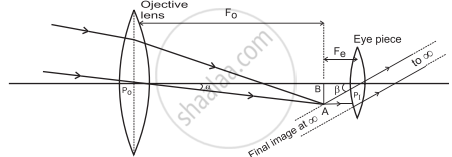
Telescope - The parallax at the cross wires can be avoided by using the telescopes in normal adjustments.
- The objective of focal length fo focusses the parallel incident beam at a distance fo from the objective giving an inverted image AB.
- For normal adjustment, the intermediate image AB forms at the focus of the eye lens. Rays refracted beyond the eye lens form a parallel beam inclined at an angle β with the principal axis.
- Angular magnification or magnifying power for telescope is given by,
M = `β/α≈(tan(β))/(tan(α))=("BA/P"_"e""B")/("BA/P"_"o""B")="f"_"o"/"f"_"e"` - Length of the telescope for normal adjustment is, L = fo + fe.
APPEARS IN
संबंधित प्रश्न
Answer the following question in detail.
Define and describe the magnifying power of an optical instrument.
Answer the following question in detail.
Derive an expression for the magnifying power of a simple microscope. Obtain its minimum and maximum values in terms of its focal length.
Answer the following question in detail.
What is a terrestrial telescope and an astronomical telescope?
Answer the following question in detail.
What is the limitation in increasing the magnifying powers of a compound microscope?
Discuss about simple microscope and obtain the equations for magnification for near point focusing and normal focusing.
What are the advantages and disadvantages of using a reflecting telescope?
What is the use of collimator in a spectrmeter?
What is the remedy of myopia?
What is hypermetropia?
What is the remedy of hypermetropia?
Discuss about astronomical telescope.
Mention different parts of the spectrometer.
A compound microscope has a magnification of 30. The focal length of eye piece is 5 cm. Assuming the final image to be at least distance of distinct vision, find the magnification produced by the objective.
A compound microscope has a magnifying power of 100 when the image is formed at infinity. The objective has a focal length of 0.5 cm and the tube length is 6.5 cm. What is the focal length of the eyepiece.
The near point and the far point for a person are 50 cm and 500 cm, respectively. Calculate the power of the lens the person should wear to read a book held in hand at 25 cm. What maximum distance is clearly visible for the person with this lens on the eye?
If astronomical telescope of length 1.53 m has magnifying power of magnitude 50, the values of fo and fe are ____________.
An object viewed from a near point distance of 25 cm, using a microscopic lens with magnification '6', gives an unresolved image. A resolved image is observed at infinite distance with a total magnification double the earlier using an eyepiece along with the given lens and a tube of length 0.6 m, if the focal length of the eyepiece is equal to ______ cm.
Magnification produced by astronomical telescope for normal adjustment is 10 and length of telescope is 1.1 m. The magnification when the image is formed at least distance of distinct vision (D = 25 cm) is ______.
An observer looks at a distant tree of height 10 m with a telescope of magnifying power of 20. To the observer the tree appears:
The image formed by an objective of a compound microscope is ______.
In the adjoining figure, AB represents the incident ray, and BK is the reflected ray. If angle BCF = θ, then ∠BFP is given by ______.
A camera objective has an aperture diameter of d. If the aperture is reduced to diameter d/2, the exposure time under identical conditions of light should be made ______.
