Advertisements
Advertisements
प्रश्न
Answer the following in detail.
List four methods of magnetizing a magnetic substance.
Advertisements
उत्तर
Methods of magnetizing a magnetic material are :
- Single-touch method – A magnet is rubbed along the magnetic substance from one end to another.
- Double-touch method – Opposite poles of two magnets are placed next to each other at the centre of the magnetic substance and rubbed in opposite direction along it.
- Magnetizing by induction – It is a method to make temporary magnets under the influence of a magnetizing force. The magnetic properties disappear when the influence of the magnetizing force is removed.
(A permanent magnet is brought close to the magnetic substance but not touched.) - Electric current – A magnet made by using electric current is called an electromagnet. It is a temporary magnet and stops behaving like a magnet when the current is stopped. Electromagnets can become permanent magnets if certain materials like steel and special alloys are placed in a coil and a very strong current is passed through the coil.
APPEARS IN
संबंधित प्रश्न
Match the following
| Column A | Column B |
| (a). Human body | (1). electric bell |
| (b). Silk thread | (2). current |
| (c). Charge in motion | (3). conductor |
| (d). soft iron | (4). electromagnet |
| (e) . Electromagnet | (5). insulator |
You are given a magnet. How will you use it to find north-south direction at a place?
Select the correct answer
An example of natural magnet is
State if the following statement is true or false. Correct the statement if it is false.
Attraction is the surest test for magnetism.
State if the following statement is true or false. Correct the statement if it is false.
As we move away from a magnet, its attraction power weakens.
A magnet remains steady in a ________ direction.
Bar magnets are often stored in pairs as shown in the figure. E and F being pieces of metal.
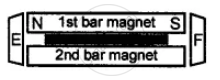
Name the metal used for E and F.
Write a short note on lighting conductors.
Distinguish between
Natural and artificial magnets.
