Advertisements
Advertisements
प्रश्न
Answer briefly.
Explain what is meant by phase of a wave.
Advertisements
उत्तर
- The state of the oscillation of a particle is called the phase of the particle.
- The displacement, direction of velocity, and oscillation number of the particle describe the phase of the particle at a place.

Displacement as a function of distance along the wave - Particles r and t (q and u or v and s) have the same displacements but the directions of their velocities are opposite.
- Particles having same magnitude of displacements and the same direction of velocity are said to be in phase during their respective oscillations. Example: particles v and p.
- Separation between two particles which are in phase is wavelength (λ).
- The two successive particles differ by ‘1’ in their oscillation number i.e., if particle v is at its nth oscillation, particle p will be at its (n +1)th oscillation as the wave is travelling along + X direction.
- In the given graph, if the disturbance (energy) has just reached the particle w, the phase angle corresponding to particle is 0°. At this instant, particle v has completed quarter oscillation and reached its positive maximum (sin θ = +1). The phase angle θ of this particle v is `pi^"c"/2` = 90° at this instant.
- Phase angles of particles u and q are π c (180°) and 2πc (360°) respectively.
- Particle p has completed one oscillation and is at its positive maximum during its second oscillation.
∴ phase angle = 2πc + `pi^"c"/2 = (5pi^"c")/2`. - v and p are the successive particles in the same state (same displacement and the same direction of velocity) during their respective oscillations. Phase angle between these two differs by 2πc.
APPEARS IN
संबंधित प्रश्न
Answer briefly.
Define wavelength of a wave.
Answer briefly.
Draw a wave and indicate points which are
- in phase
- out of phase
- have a phase difference of `pi/2`
Define the relation between velocity, wavelength, and frequency of the wave.
State any four properties of progressive wave.
Solve the following problem.
A tuning fork of frequency 170 Hz produces sound waves of wavelength 2 m. Calculate the speed of sound.
Sound wave A has period 0.015 s, sound wave B has a period of 0.025 s. Which sound has greater frequency?
Two sinusoidal plane waves of the same frequency having intensities I0 and 4I0 are travelling in the same direction. The resultant intensity at a point at which waves meet with a phase difference of zero radians is ______
Two waves of the same amplitude superimpose to produce two beats per second. What is the ratio of minimum loudness to that of one of the waves?
The ratio of minimum to maximum wavelength in Balmer series is ____________.
When the kinetic energy of an electron is increased, the wavelength of the associated wave will ______.
The following figure shows the shape of part of a long string in which transverse waves are produced by attaching one end of the slring to tuning fork of frequency 300 Hz. The velocity of the waves is ____________.
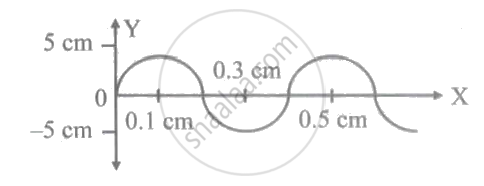
If velocity of sound in a gas is 360 m/s and the distance between a compression and the nearest rarefaction is 2 m, then the frequency of sound is ____________.
In a closed pipe, the note of fundamental frequency can be produced if the length of the air column is equal to ____________.
The frequency of a tuning fork is 220 Hz and the velocity of sound in air is 330 m/s. When the tuning fork completes 80 vibrations, the distance travelled by the ______.
When the observer moves towards a stationary source with velocity V1, the apparent frequency of emitted note is F1. When observer moves away from the source with velocity V1, the apparent frequency is F2. If V is the velocity of sound in air and `"F"_1/"F"_2=2` then `"V"/"V"_1` is equal to ______.
The displacement-time graphs of two particles A and B are straight lines making angles of 30° and 60° respectively with the time axis. If the velocity of A is vA and that of B is vB, the value of vA/vB is ______.
In communication system, the process of superimposing a low frequency signal on a high frequency wave is known as ______.
A source of 300 Hz frequency, an observer and a wind are moving as shown in the figure with respect to the ground. The frequency heard by observation is ______.
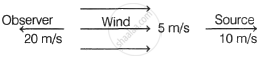
(Take, the speed of sound in air = 340 m/s)
Two instruments having stretched strings are being played in unison. When the tension of one of the instruments is increased by 1%, 3 beats are produced in 2 s. The initial frequency of vibration of each wire is ______.
An astronaut is approaching the moon. He sends out a radio signal of frequency 5000 MHz and the frequency of echo is different from that of the original frequency by 100 kHz. His velocity of approach wrt, to the moon, is ______.
The energy of photon corresponding to a radiation of wavelength 600 nm is 3.32 × 10⁻¹⁹ J. The energy of a photon corresponding to a wavelength of 400 nm is ______.
