Advertisements
Advertisements
प्रश्न
Answer in 100-150 Words
Why Did the Mutinous Sepoys in Many Places Turn to Erstwhile Rulers to Provide Leadership to the Revolt?
Advertisements
उत्तर
Following are the major reasons to explain why the rebellious soldiers turned to native rulers for leadership:
1.East India company defeated native rulers to grab power in India. Many believed that the native Indian rulers had the legal and legitimate authority to regain power in the respective kingdoms. Therefore, it was natural that they became the leaders of the rebels and regain the lost status of rulers.
2.The erstwhile rulers had substantial resources at their command. They had wealth and private armies too. The rebels waited to get the support of resources from them, and by declaring them the leaders it was natural outcome.
3.Most of the erstwhile Indian rulers were popular at the local level. Their subjects
often sympathised with them as they believed that the latter were unlawfully
thrown out of power and even suffered humiliation. Choosing these native rulers was echoing the sentiments of the people and winning more support for the cause.
APPEARS IN
संबंधित प्रश्न
Write a short essay (250-300 words) on the following:
Examine any two sources presented in the chapter, choosing one visual and one text, and discuss how these represent the point of view of the victor and the vanquished.
What is a Bell of arms?
Where did the Mutiny begin?
What do you understand by the term ‘Firangi’?
Who led the revolt in Bihar?
Which of the following was the immediate cause of the Revolt of 1857?
Match the following.
| (i) | Rani Lakshmi Bai | (a) | Kanpur |
| (ii) | Nana Sahib | (b) | Singhbhum |
| (iii) | Kunwar Singh | (c) | Jhansi |
| (iv) | Gonoo | (d) | Arrah |
Choose the correct option.
Arrange the following events in chronological order:
- Introduction of Summary Revenue Settlement
- Subsidiary Alliance introduced in Awadh
- Rani Jhansi killed in the battle
- Delhi captured by the British June
Choose the correct option.
Assertion (A): In towns and cantonments, sepoys and the common people refused to touch the atta.
Reason (R): There were rumours that the British had mixed the bone dust of cows and pigs into the flour that was sold in the market.
Who was forced to lead the revolt?
Which of these was the reason for Nana Saheb’s joining the revolt of 1857?
Indicate which of the following is not correct.
Read the following excerpt carefully and answer the question :
Rumours and prophecies played a part in moving people to action. The Sepoys who had arrived in Delhi from Meerut had told Bahadur Shah about the bullets coated with the fat of cow and pigs and that biting those bullets would corrupt their caste and religion. They were referring to the cartridges of the Enfield Rifles that had just been given to them. The British tried to explain to the Sepoys that this was not the case but the rumour of greased cartridge spread like wildfire across the Sepoy lines of North India.
Why did the Sepoys march to Delhi from Meerut?
On the same outline map of India, a place related to the centres of the Revolt of 1857 is marked as A. Identify it and write its name on the line drawn near them.
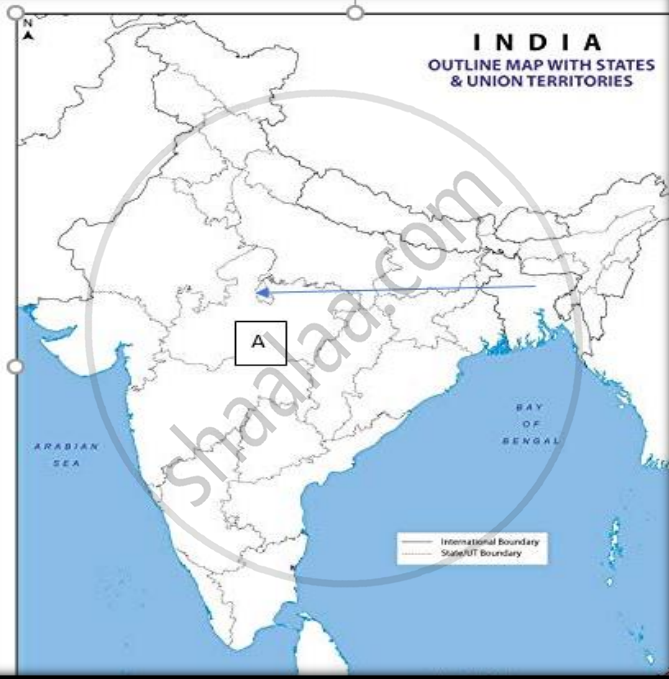
From where did the revolt of 1857 start?
Consider the following statements regarding the revolt of 1857:
- Late in the afternoon of 10 May 1857, the sepoys in the cantonment of Meerut broke out in mutiny which began in the lines of the native infantry, spread very swiftly to the cavalry and then to the city
- The ordinary people of the town and surrounding villages joined the sepoys. The sepoys captured the bell of arms where the arms and ammunition were kept and proceeded to attack white people, and to ransack and bum their bungalows and property.
- The sepoys arrived at the gates of the Red Fort early in the morning on 11 May.
Which of the following statement(s) is/ are correct?
Consider the following statements regarding the 1857 mutiny when reached Delhi:
- The sepoys from Meerut arrived at the gates of the Red Fort early in the morning on 11 May.
- Europeans had been protected by the rich people in Delhi.
- Once word spread that Delhi had fallen to the rebels and Bahadur Shah had blessed the rebellion, events moved swiftly.
Which of the following statement(s) is/are correct?
The tradition of Sati was abolished in the year:
Who was the prominent leader in Delhi during the Revolt of 1857?
"The Sepoys Mutiny and the rebellion of 1857" written by:
Who founded the Indian Home Rule League?
Shah Mal become the leaders of Revolt 1857 of Pargana Baraut in ______.
Captain Hearsey was given protection by ______.
Consider the following statements regarding revolt of 1857.
- Mughal Emperor Bahadur Shah was declared as the leader of sepoys.
- There was no participation of common people.
- Moneylenders and the rich were attacked.
Which of the above statement is/are correct?
Which of the following pairs is correctly matched?
'British, did not have an easy time in putting down the Revolt of 1857.' Explain the statement with examples.
Which of the following issues did not contribute to the spread of the Revolt of 1857?
Who among the following led the Flag of the Revolt 1857 against the British in Bihar?
