Advertisements
Advertisements
प्रश्न
Anannya responded to the question: Why do electrical appliances with metallic bodies are connected to the mains through a three-pin plug, whereas an electric bulb can be connected with a two-pin plug?
She wrote: Three-pin connections reduce heating of connecting wires.
- Is her answer correct or incorrect? Justify.
- What is the function of a fuse in a domestic circuit?
Advertisements
उत्तर
- Anannya’s answer is wrong. Electrical appliances with metallic bodies need an earth wire which provides a low resistance conducting path to the flow of current, in case there is an accidental leakage of current through the conducting body of the appliances.
- An electrical fuse is a safety device that operates to provide protection against the overflow of current in an electrical circuit. An important component of an electrical fuse is a metal wire or strip that melts when excess current flows through it.
APPEARS IN
संबंधित प्रश्न
An electric iron of resistance 20 Ω takes a current of 5 A. Calculate the heat developed in 30 s.
An electric heater of resistance 8 Ω draws 15 A from the service mains 2 hours. Calculate the rate at which heat is developed in the heater.
Name the factors on which the heat produced in a wire depends when current is passed in it, and state how does it depend on the factors stated by you.
Which of the following substance contracts on heating?
Explain the application of heating effect of electric current in an electric bulb with a diagram.
True or False – If False give the correct answer
The fuse wire does not melts whenever there is overload in the wiring.
(a) Observe the diagram given below and state whether the bulb will glow or not when we switch on K.
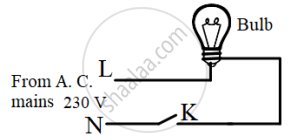
(b) Is it safe to handle the bulb when the switch is OFF?
(c) Give a reason for your answer in (b).
What is an electric fuse made up of?
Explain why fuse wire is always connected in a series arrangement.
An electric iron is rated 220 V, 2 kW. If the iron is used for 3h daily find the cost of running it for one week if it costs ₹ 4.25 per kWh.
