Advertisements
Advertisements
प्रश्न
An oil company has two depots, A and B, with capacities of 7000 litres and 4000 litres respectively. The company is to supply oil to three petrol pumps, D, E, F whose requirements are 4500, 3000 and 3500 litres respectively. The distance (in km) between the depots and petrol pumps is given in the following table:
Figure
Assuming that the transportation cost per km is Rs 1.00 per litre, how should the delivery be scheduled in order that the transportation cost is minimum?
Advertisements
उत्तर
Let x and y litres of oil be supplied from A to the petrol pumps D and E. Then, (7000 − x − y) L will be supplied from A to petrol pump F.
The requirement at petrol pump D is 4500 L. Since, x L are transported from depot A, the remaining (4500 −x) L will be transported from petrol pump B.
Similarly, (3000 − y) L and [3500 − (7000 − x − y)] L i.e. (x + y − 3500) L will be transported from depot B to petrol pump E and F. respectively.
The given problem can be represented diagrammatically as follows. 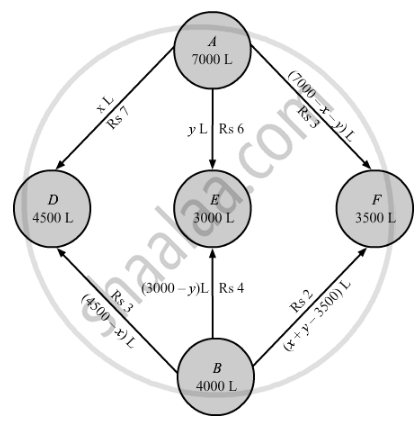
Since, quantity of oil are non-negative quantities.Therefore,
x ≥0 , y ≥ 0, and (7000 - x - y ) ≥ 0
⇒ x ≥ 0 , y ≥ 0, and x + y ≥ 7000
4500 - x ≥ 0 , 3000 - y ≥ 0 , and x + y -3500 ≥ 0
⇒ x ≤ 4500, y ≤ 3000, and x + y ≥ 3500
Cost of transporting 10 L of petrol = Re 1
Cost of transporting 1 L of petrol = \[Rs \frac{1}{10}\]
Therefore, total transportation cost is given by,
`z = 7/10 xx x+6/10 y + 3/10 (7000 - x -y ) + 3/10 (4500 - x) + 4/10 ( 3000 - y ) + 2/10( x + y - 3500)`
= 0.3x + 0.1y + 3950
The problem can be formulated as follows.
Minimize Z = 0.3x + 0.1y + 3950
subject to the constraints,
\[x + y \leq 7000\]
\[x \leq 4500\]
\[y \leq 3000\]
\[x + y \geq 3500\]
\[x, y \geq 0\]
First we will convert inequations into equations as follows:
x + y = 7000, x = 4500, y = 3000, x + y = 3500, x = 0 and y = 0
Region represented by x + y ≤ 7000:
The line x + y = 7000 meets the coordinate axes at A1(7000, 0) and \[B_1 \left( 0, 7000 \right)\] respectively. By joining these points we obtain the line x + y = 7000 . Clearly (0,0) satisfies the x + y = 7000 . So, the region which contains the origin represents the solution set of the inequation x + y ≤ 7000.
Region represented by x ≤ 4500:
The line x = 4500 is the line passes through C1(4500, 0) and is parallel to Y axis. The region to the left of the line x = 4500 will satisfy the inequation
x ≤ 4500.
Region represented by y ≤ 3000:
The line y = 3000 is the line passes through D1(0, 3000) and is parallel to X axis. The region below the the line y = 3000 will satisfy the inequation
y ≤ 3000.
Region represented by x + y ≥ 3500:
The line x + y = 7000 meets the coordinate axes at E1(3500, 0) and \[F_1 \left( 0, 3500 \right)\] respectively. By joining these points we obtain the line
x + y = 3500 . Clearly (0,0) satisfies the x + y = 3500. So, the region which contains the origin represents the solution set of the inequation x + y ≥ 3500.
Region represented by x ≥ 0 and y ≥ 0:
Since, every point in the first quadrant satisfies these inequations. So, the first quadrant is the region represented by the inequations x ≥ 0, and y ≥ 0.
The feasible region determined by the system of constraints x + y ≤ 7000, x ≤ 4500, y ≤ 3000, x + y ≥ 3500, x ≥ 0 and y ≥ 0 are as follows.
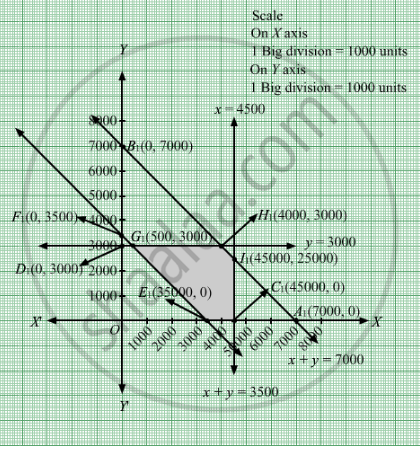
The corner points of the feasible region are E1(3500, 0), C1(4500, 0), I1(4500, 2500), H1(4000, 3000), and G1(500, 3000).
The values of Z at these corner points are as follows.
| Corner point | Z = 0.3x + 0.1y + 3950 |
| E1(3500, 0) | 5000 |
| C1(4500, 0) | 5300 |
| I1(4500, 2500) | 5550 |
| H1(4000, 3000) | 5450 |
| G1(500, 3000) | 4400 |
The minimum value of Z is 4400 at G1(500, 3000).
Thus, the oil supplied from depot A is 500 L, 3000 L, and 3500 L and from depot B is 4000 L, 0 L, and 0 L to petrol pumps D, E, and F respectively.
The minimum transportation cost is Rs 4400.
APPEARS IN
संबंधित प्रश्न
Minimize `z=4x+5y ` subject to `2x+y>=7, 2x+3y<=15, x<=3,x>=0, y>=0` solve using graphical method.
Minimize: Z = 6x + 4y
Subject to the conditions:
3x + 2y ≥ 12,
x + y ≥ 5,
0 ≤ x ≤ 4,
0 ≤ y ≤ 4
A retired person wants to invest an amount of Rs. 50, 000. His broker recommends investing in two type of bonds ‘A’ and ‘B’ yielding 10% and 9% return respectively on the invested amount. He decides to invest at least Rs. 20,000 in bond ‘A’ and at least Rs. 10,000 in bond ‘B’. He also wants to invest at least as much in bond ‘A’ as in bond ‘B’. Solve this linear programming problem graphically to maximise his returns.
Find graphically, the maximum value of z = 2x + 5y, subject to constraints given below :
2x + 4y ≤ 83
x + y ≤ 6
x + y ≤ 4
x ≥ 0, y≥ 0
Solve the following LPP by graphical method:
Maximize: z = 3x + 5y
Subject to: x + 4y ≤ 24
3x + y ≤ 21
x + y ≤ 9
x ≥ 0, y ≥ 0
Also find the maximum value of z.
Solve the following L.P.P. graphically:
Minimise Z = 5x + 10y
Subject to x + 2y ≤ 120
Constraints x + y ≥ 60
x – 2y ≥ 0 and x, y ≥ 0
Maximise z = 8x + 9y subject to the constraints given below :
2x + 3y ≤ 6
3x − 2y ≤6
y ≤ 1
x, y ≥ 0
Maximize Z = 7x + 10y
Subject to
\[x + y \leq 30000\]
\[ y \leq 12000\]
\[ x \geq 6000\]
\[ x \geq y\]
\[ x, y \geq 0\]
Minimize Z = 30x + 20y
Subject to
\[x + y \leq 8\]
\[ x + 4y \geq 12\]
\[5x + 8y = 20\]
\[ x, y \geq 0\]
Maximize Z = −x1 + 2x2
Subject to
\[- x_1 + 3 x_2 \leq 10\]
\[ x_1 + x_2 \leq 6\]
\[ x_1 - x_2 \leq 2\]
\[ x_1 , x_2 \geq 0\]
Solve the following linear programming problem graphically:
Minimize z = 6 x + 3 y
Subject to the constraints:
4 x + \[y \geq\] 80
x + 5 \[y \geq\] 115
3 x + 2 \[y \leq\] 150
\[x \geq\] 0 , \[y \geq\] 0
A diet for a sick person must contain at least 4000 units of vitamins, 50 units of minerals and 1400 of calories. Two foods A and B, are available at a cost of Rs 4 and Rs 3 per unit respectively. If one unit of A contains 200 units of vitamin, 1 unit of mineral and 40 calories and one unit of food B contains 100 units of vitamin, 2 units of minerals and 40 calories, find what combination of foods should be used to have the least cost?
A furniture manufacturing company plans to make two products : chairs and tables. From its available resources which consists of 400 square feet to teak wood and 450 man hours. It is known that to make a chair requires 5 square feet of wood and 10 man-hours and yields a profit of Rs 45, while each table uses 20 square feet of wood and 25 man-hours and yields a profit of Rs 80. How many items of each product should be produced by the company so that the profit is maximum?
Anil wants to invest at most Rs 12000 in Saving Certificates and National Saving Bonds. According to rules, he has to invest at least Rs 2000 in Saving Certificates and at least Rs 4000 in National Saving Bonds. If the rate of interest on saving certificate is 8% per annum and the rate of interest on National Saving Bond is 10% per annum, how much money should he invest to earn maximum yearly income? Find also his maximum yearly income.
A library has to accommodate two different types of books on a shelf. The books are 6 cm and 4 cm thick and weigh 1 kg and \[1\frac{1}{2}\] kg each respectively. The shelf is 96 cm long and atmost can support a weight of 21 kg. How should the shelf be filled with the books of two types in order to include the greatest number of books? Make it as an LPP and solve it graphically.
A manufacturing company makes two models A and B of a product. Each piece of model A requires 9 labour hours for fabricating and 1 labour hour for finishing. Each piece of model B requires 12 labour hours for fabricating and 3 labour hours for finishing. For fabricating and finishing, the maximum labour hours available are 180 and 30 respectively. The company makes a profit of ₹8000 on each piece of model A and ₹12000 on each piece of model B. How many pieces of model A and model B should be manufactured per week to realise a maximum profit? What is the maximum profit per week?
There are two factories located one at place P and the other at place Q. From these locations, a certain commodity is to be delivered to each of the three depots situated at A, B and C. The weekly requirements of the depots are respectively 5, 5 and 4 units of the commodity while the production capacity of the factories at P and Q are respectively 8 and 6 units. The cost of transportation per unit is given below:
| From \ To | Cost (in ₹) | ||
| A | B | C | |
| P | 160 | 100 | 150 |
| Q | 100 | 120 | 100 |
How many units should be transported from each factory to each depot in order that the transportation cost is minimum. What will be the minimum transportation cost?
A medical company has factories at two places, A and B. From these places, supply is made to each of its three agencies situated at P, Q and R. The monthly requirements of the agencies are respectively 40, 40 and 50 packets of the medicines, while the production capacity of the factories, A and B, are 60 and 70 packets respectively. The transportation cost per packet from the factories to the agencies are given below:
| Transportation Cost per packet(in Rs.) | ||
| From-> | A | B |
| To | ||
| P | 5 | 4 |
| Q | 4 | 2 |
| R | 3 | 5 |
A company manufactures two types of cardigans: type A and type B. It costs ₹ 360 to make a type A cardigan and ₹ 120 to make a type B cardigan. The company can make at most 300 cardigans and spend at most ₹ 72000 a day. The number of cardigans of type B cannot exceed the number of cardigans of type A by more than 200. The company makes a profit of ₹ 100 for each cardigan of type A and ₹ 50 for every cardigan of type B.
Formulate this problem as a linear programming problem to maximize the profit to the company. Solve it graphically and find the maximum profit.
Sketch the graph of inequation x ≥ 5y in xoy co-ordinate system
Draw the graph of inequalities x ≤ 6, y −2 ≤ 0, x ≥ 0, y ≥ 0 and indicate the feasible region
The maximum value of z = 6x + 8y subject to x - y ≥ 0, x + 3y ≤ 12, x ≥ 0, y ≥ 0 is ______.
The maximum value of Z = 5x + 4y, Subject to y ≤ 2x, x ≤ 2y, x + y ≤ 3, x ≥ 0, y ≥ 0 is ______.
For the function z = 19x + 9y to be maximum under the constraints 2x + 3y ≤ 134, x + 5y ≤ 200, x ≥ 0, y ≥ 0; the values of x and y are ______.
The maximum value of Z = 3x + 4y subjected to contraints x + y ≤ 40, x + 2y ≤ 60, x ≥ 0 and y ≥ 0 is ____________.
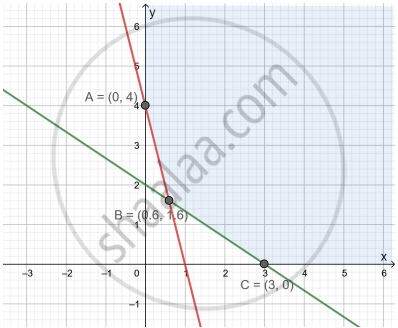
The corner points of the shaded unbounded feasible region of an LPP are (0, 4), (0.6, 1.6) and (3, 0) as shown in the figure. The minimum value of the objective function Z = 4x + 6y occurs at ______.
Solve the following Linear Programming Problem graphically:
Maximize Z = 400x + 300y subject to x + y ≤ 200, x ≤ 40, x ≥ 20, y ≥ 0
Solve the following linear programming problem graphically:
Maximize: Z = x + 2y
Subject to constraints:
x + 2y ≥ 100,
2x – y ≤ 0
2x + y ≤ 200,
x ≥ 0, y ≥ 0.
The feasible region corresponding to the linear constraints of a Linear Programming Problem is given below.

Which of the following is not a constraint to the given Linear Programming Problem?
The solution set of constraints x + 2y ≥ 11, 3x + 4y ≤ 30, 2x + 5y ≤ 30 and x ≥ 0, y ≥ 0, includes the point ______.
Which point is an infeasible solution?
The Corner Point Method is based on which theorem?
What does the Extreme Point Theorem state about the optimum solution of an LPP, if it exists?
What is the value of \[Z=4x+y\] at the corner point \[(30,0)\]?
For \[Z=4x+y\], which corner point gives the maximum value subject to \[x+y\leq50\], \[3x+y\leq90\], \[x\geq0\], and \[y\geq0\]?
