Advertisements
Advertisements
प्रश्न
An object is put in three liquids having different densities, one by one. The object floats with `1/9` , `2/11` and `3/7` parts of its volume outside the surface of liquids of densities d1, d2 and d3 respectively. Which of the following is the correct order of the densities of the three liquids?
पर्याय
d1 > d2 > d3
d2 > d3 > d1
d1 < d2 < d3
d3 > d2 > d1
Advertisements
उत्तर
d1<d2<d3.
This is because if the density of the liquid is more than the object, then the object will float on the liquid. The more the object gets immersed in the liquid, lesser is the density of the liquid.
APPEARS IN
संबंधित प्रश्न
If the relative density of a substance is 7.1, what will be its density in SI units ?
Calculate the density of an object of volume 3 m3 and mass 9 kg. State whether this object will float or sink in water. Give reason for your answer.
A body floats in kerosene of density 0.8 x 10³ kg/m3 up to a certain mark. If the same body is placed in water of density 1.0 x 10³ kg/m3, will it sink more or less ? Give reason for your answer.
When a golf ball is lowered into a measuring cylinder containing water, the water level rises by 30 cm3 when the ball is completely submerged. If the mass of ball in air is 33 g, find its density.
A piece of steel has a volume of 12 cm3, and a mass of 96 g. What is its density in kg/m3 ?
The relative densities of four liquids P, Q, R and S are 1.26, 1.0, 0.84 and 13.6 respectively. An object is floated in all these liquids, one by one. In which liquid the object will float with its maximum volume submerged under the liquid?
A solid of density 900 kg/m3 floats in oil as shown in the given diagram. The oil floats on water of density 1000 kg/m3 as shown. The density of oil kg/m3 could be :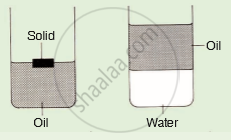
Calculate the average density of the earth in terms of g, G and R
To find out the relative density of the substance, with respect to the density of water ______C is taken.
Describe the construction and working of the Pycnometer.
