Advertisements
Advertisements
प्रश्न
An element `""_ZS^A` decays to `""_85R^222` after emitting 2 α particles and 1 β particle.
Find the atomic number and atomic mass of the element S.
Advertisements
उत्तर
`""_ZS^A -> ""_85R^222 + 2(""_2^4He) + 1 ""_"-1"^0e`
A = 222 + 2(4) + 0
∴ A = 230
Z = 85 + 2(2) + (-1)
∴ Z = 88
APPEARS IN
संबंधित प्रश्न
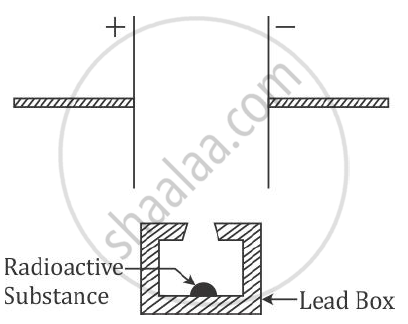
Complete the diagram as given above by drawing the deflection of radioactive radiations in an electric field
Radiations given out from a source when subjected to an electric field in a direction perpendicular to their path are shown below in the diagram. The arrows show the path of the radiation A, B and C. Answer the following questions in terms of A, B and C.
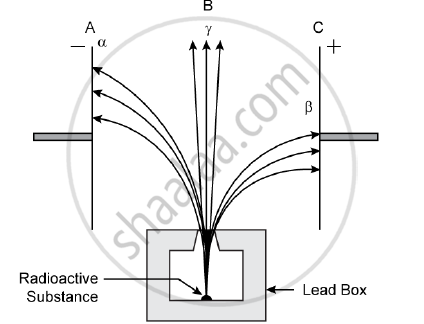
1) Name the radiation B which is unaffected by the electrostatic field.
2) Why does the radiation C deflect more than A?
3) Which among the three causes the least biological damage externally.
4) Name the radiation which is used in carbon dating.
What is nucleus of an atom? Compare its size with that of the atom. Name its constitutents. How is the number of these constituents determined by the atomic number its atomic model.
What happens to the position of an element in the periodic table when it emits an alpha particle
An element P disintegrates by α - -emission and the new element suffers two further disintegrations, both by β -emission, to form an element Q. Explain the fact that P and Q are the isotopes.
Why should a radioactive substance not be touched by hands?
How is a cathode ray beam affected while passing through a magnetic field?
What are ‘Becquerel rays’?
Justify with reason, whether the following nuclear reactions are allowed or not.
\[\ce{^A_Z X -> ^A_{Z + 1}Y + ^0_{-1}β}\]
Mention four properties of Becquerel rays.
