Advertisements
Advertisements
प्रश्न
An electron is accelerated through a potential difference of 100 volts. Calculate de-Broglie wavelength in nm.
Advertisements
उत्तर
V = 100 volts
∴ `lambda = 1.228/sqrt"V" = 1.228/sqrt100 = 1.228/10 = 0.1228` nm
APPEARS IN
संबंधित प्रश्न
An electron, a proton, an α-particle, and a hydrogen atom are moving with the same kinetic energy. The associated de Broglie wavelength will be longest for ______.
State the importance of Davisson and Germer experiment.
What is the speed of a proton having de Broglie wavelength of 0.08 Å?
The de Broglie wavelengths associated with an electron and a proton are the same. What will be the ratio of
- their momenta
- their kinetic energies?
Calculate De Broglie's wavelength of the bullet moving with speed 90m/sec and having a mass of 5 gm.
Explain De Broglie’s Hypothesis.
The momentum of a photon of energy 1 MeV in kg m/s will be ______
The de Broglie wavelength associated with photon is, ____________.
If the radius of the innermost Bohr orbit is 0.53 Å, the radius of the 4th orbit is ______
If the radius of the circular path and frequency of revolution of a particle of mass m are doubled, then the change in its kinetic energy will be (Ei and Ef are the initial and final kinetic energies of the particle respectively.)
A particle of charge q, mass m and energy E has de-Broglie wavelength `lambda.` For a particle of charge 2q, mass 2m and energy 2E, the de-Broglie wavelength is ____________.
The wavelength '`lambda`' of a photon and de-Broglie wavelength of an electron have same value. The ratio of energy of a photon to kinetic energy of electron is (m = mass of electron, c = velocity of light, h = Planck's constant) ____________.
If '`lambda_1`' and '`lambda_2`' are de-Broglie wavelengths for electrons in first and second Bohr orbits in hydrogen atom, then the ratio '`lambda_2`' to '`lambda_1`' is (E1 = -13.6 eV) ____________.
If the kinetic energy of a particle is increased to 16 times its previous value, the percentage change in the de-Broglie wavelength of the particle is ____________.
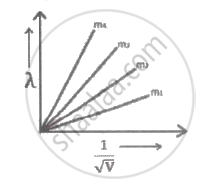
Graph shows the variation of de-Broglie wavelength `(lambda)` versus `1/sqrt"V"`, where 'V' is the accelerating potential for four particles carrying same charge but of masses m1 , m2, m3, m4. Which particle has a smaller mass?
A photon of wavelength 3315 Å falls on a photocathode and an electron of energy 3 x 10-19 J is ejected. The threshold wavelength of photon is [Planck's constant (h) = 6.63 x 10⁻³⁴ J.s, velocity of light (c) = 3 x 10⁸ m/s] ____________.
Explain de-Broglie wavelength.
A proton, a neutron, an electron and an α-particle have same energy. λp, λn, λe and λα are the de Broglie's wavelengths of proton, neutron, electron and α particle respectively, then choose the correct relation from the following :
The energy of an electron having de-Broglie wavelength `λ` is ______.
(h = Plank's constant, m = mass of electron)
An electron of mass m has de-Broglie wavelength λ when accelerated through potential difference V. When proton of mass M, is accelerated through potential difference 9V, the de-Broglie wavelength associated with it will be ______. (Assume that wavelength is determined at low voltage)
Calculate the de Broglie wavelength associated with an electron moving with a speed of `5 xx 10^6` m/s. `(m_e = 9.1 xx 10^(-31)kg)`
A proton, an electron and an alpha particle have the same energies. Their de-Broglie wavelengths will be compared as ______.
