Advertisements
Advertisements
प्रश्न
ABCD is a parallelogram and P is the point of intersection of its diagonals. If O is the origin of reference, show that
\[\vec{OA} + \vec{OB} + \vec{OC} + \vec{OD} = 4 \vec{OP}\]
Advertisements
उत्तर
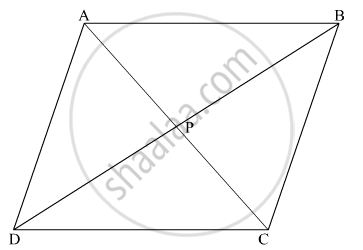
Given a parallelogram ABCD and P is the point of intersection of its diagonals. We know the diagonals of a parallelogram, bisect each other. Therefore,
\[\frac{\vec{OA} + \vec{OC}}{2} = \vec{OP} \]
\[ \vec{OA} + \vec{OC} = 2 \vec{OP} . . . . . \left( 1 \right)\]
\[\text{ and }\frac{\vec{OB} + \vec{OD}}{2} = \vec{OP} \]
\[ \vec{OB} + \vec{OD} = 2 \vec{OP} . . . . . \left( 2 \right)\]
Adding (1) and (2), We get,
\[\vec{OA} + \vec{OB} + \vec{OC} + \vec{OD} = 4 \vec{OP}\]
shaalaa.com
या प्रश्नात किंवा उत्तरात काही त्रुटी आहे का?
