Advertisements
Advertisements
प्रश्न
ABCD is a parallelogram and X is the mid-point of AB. If ar (AXCD) = 24 cm2, then ar (ABC) = 24 cm2.
पर्याय
True
False
Advertisements
उत्तर
This statement is False.
Explanation:
Given in the question, ABCD is a parallelogram and X is the mid-point of AB.
So, area(ABCD) = area(AXCD) + area(ΔXBC) ...(i)
Now, diagonal AC of a parallelogram divides it into two triangles of equal area.
area(ABCD) = 2area(ΔABC) ...(ii)
Similarly, X is the mid-point of AB,
So, area(ΔCXB) = `1/2`area(ΔABC) ...(iii) [Median divides the triangle in two triangles of equal area]
2area(ΔABC) = `24 + 1/2` area(ΔABC) ...[By using equation (i), (ii) and (iii)]
Now, 2area(ΔABC) – `1/2`area(ΔABC) = 24
`3/2`area(ΔABC) = 24
Therefore, area(ΔABC) = `(2 xx 24)/3` = 16 cm2.
APPEARS IN
संबंधित प्रश्न
D, E and F are respectively the mid-points of the sides BC, CA and AB of a ΔABC. Show that
(i) BDEF is a parallelogram.
(ii) ar (DEF) = 1/4ar (ABC)
(iii) ar (BDEF) = 1/2ar (ABC)
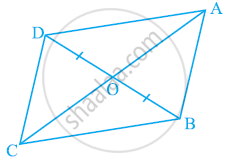
In the given figure, diagonals AC and BD of quadrilateral ABCD intersect at O such that OB = OD. If AB = CD, then show that:
(i) ar (DOC) = ar (AOB)
(ii) ar (DCB) = ar (ACB)
(iii) DA || CB or ABCD is a parallelogram.
[Hint: From D and B, draw perpendiculars to AC.]
XY is a line parallel to side BC of a triangle ABC. If BE || AC and CF || AB meet XY at E and F respectively, show that
ar (ABE) = ar (ACF)
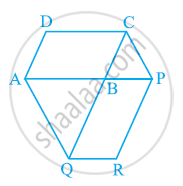
The side AB of a parallelogram ABCD is produced to any point P. A line through A and parallel to CP meets CB produced at Q and then parallelogram PBQR is completed (see the following figure). Show that
ar (ABCD) = ar (PBQR).
[Hint: Join AC and PQ. Now compare area (ACQ) and area (APQ)]
In a ΔABC, if L and M are points on AB and AC respectively such that LM || BC. Prove
that:
(1) ar (ΔLCM ) = ar (ΔLBM )
(2) ar (ΔLBC) = ar (ΔMBC)
(3) ar (ΔABM) ar (ΔACL)
(4) ar (ΔLOB) ar (ΔMOC)
If a triangle and a parallelogram are on the same base and between same parallels, then the ratio of the area of the triangle to the area of parallelogram is ______.
PQRS is a parallelogram whose area is 180 cm2 and A is any point on the diagonal QS. The area of ∆ASR = 90 cm2.
In the following figure, ABCD and EFGD are two parallelograms and G is the mid-point of CD. Then ar (DPC) = `1/2` ar (EFGD).
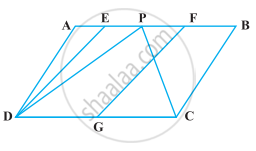
The area of the parallelogram ABCD is 90 cm2 (see figure). Find ar (ΔABD)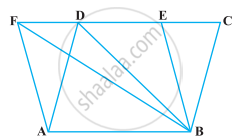
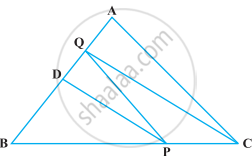
In ∆ABC, D is the mid-point of AB and P is any point on BC. If CQ || PD meets AB in Q (Figure), then prove that ar (BPQ) = `1/2` ar (∆ABC).