Advertisements
Advertisements
प्रश्न
ABC is a triangle with B as right angle, AC = 5 cm and AB = 4 cm. A circle is drawn with Aas centre and AC as radius. The length of the chord of this circle passing through C and B is
पर्याय
3 cm
4 cm
5 cm
6 cm
Advertisements
उत्तर
6 cm
We are given a right triangle ABC such that `angleB ` = 90° , AC = 5 cm, AB = 4 cm. A circle is drawn with A as centre and AC as radius. We have to find the length of the chord of this circle passing through C and B. We have the following figure regarding the given information.
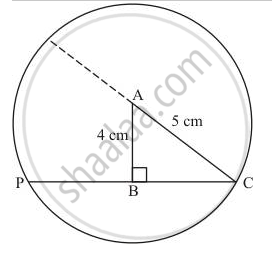
In the circle produce CB to P. Here PC is the required chord.
We know that perpendicular drawn from the centre to the chord divide the chord into two equal parts.
So, PC = 2BC
Now in ΔABC apply Pythagoras theorem
`BC^2 = AC^2 - AB^2`
`=5^2 - 4^2`
= 25 - 16
= 9
BC = 3 cm
So, PC = 2 × BC
= 2 × 3
= 6 cm
APPEARS IN
संबंधित प्रश्न
Fill in the blank
A continuous piece of a circle is ............... of the circle
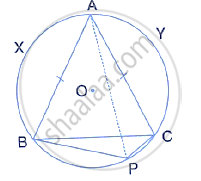
In the given figure ABC is an isosceles triangle and O is the centre of its circumcircle. Prove that AP bisects angle BPC .
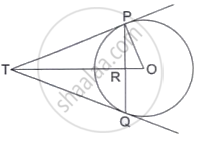
PQ is a chord of length 4.8 cm of a circle of radius 3 cm. The tangents at P and Q intersect at a point T as shown in the figure. Find the length of TP.
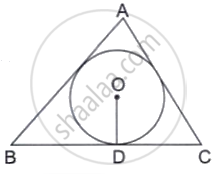
In the given figure, a triangle ABC is drawn to circumscribe a circle of radius 2 cm such that the segments BD and DC into which BC is divided by the point of contact D, are of lengths 4 cm and 3 cm respectively. If the area of ΔABC = 21 cm2 then find the lengths of sides AB and AC.
The greatest chord of a circle is called its
Use the figure given below to fill in the blank:
Tangent to a circle is _______.

State, if the following statement is true or false:
The diameters of a circle always pass through the same point in the circle.
Find the missing values in the following table for the circles with radius (r), diameter (d) and Circumference (C).
| radius (r) | diameter (d) | Circumference (C) |
| 24 m |
AD is a diameter of a circle and AB is a chord. If AD = 34 cm, AB = 30 cm, the distance of AB from the centre of the circle is ______.
From the figure, identify a sector.

