Advertisements
Advertisements
प्रश्न
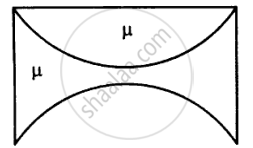
A thin plano-convex lens and a thin equi-concave lens are kept coaxially in contact as shown in the figure. Assuming both the lenses are made of glass of refractive index μ, and R is the radius of curvature of each curved surface, the focal length of the combination is:
पर्याय
`R/(mu - 1)`
`-R/(mu - 1)`
`(2R)/(mu - 1)`
`-(2R)/(mu - 1)`
Advertisements
उत्तर
`bb(-R/(mu - 1))`
Explanation:
For thin lenses placed in contact:
`1/f_(eq) = 1/f_1 + 1/f_2`
Use lens maker’s formula:
`1/f_1 = (mu - 1)(1/R_1 - 1/R_2)`
It has one curved surface and one plane surface.
`1/f_1 = (mu - 1)(1/R - 0)`
`f_1 = R/(mu - 1)`
Equi-concave lens, both surfaces concave:
R1 = −R
R2 = +R
`1/f_2 = (mu - 1)((-1)/R - 1/R)`
`1/f_2 = -(2(mu - 1))/R`
`f_2 = -R/(2(mu - 1))`
Equivalent focal length:
`1/f_(eq) = (mu - 1)/R - (2(mu - 1))/R`
`1/f_(eq) = -(mu - 1)/R`
∴ `f_(eq) = -R/(mu - 1)`
