Advertisements
Advertisements
प्रश्न
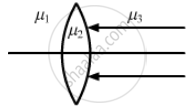
A thin lens made of a material of refractive index μ2 has a medium of refractive index μ1on one side and a medium of refractive index μ3 on the other side. The lens is biconvex and the two radii of curvature have equal magnitude R. A beam of light travelling parallel to the principal axis is incident on the lens. Where will the image be formed if the beam is incident from (a) the medium μ1 and (b) from the medium μ3?
Advertisements
उत्तर
Given,
A biconvex lens with two radii of curvature that have equal magnitude R.
Refractive index of the material of the lens is μ2.
First medium of refractive index is μ1.
Second medium of refractive index is μ3.
As per the question, the light beams are travelling parallel to the principal axis of the lens.
i.e., u (object distance) = ∞
(a) The light beam is incident on the lens from first medium μ1.
Thus, refraction takes place at first surface
Using equation of refraction,
\[\frac{\mu_2}{v} - \frac{\mu_1}{u} = \frac{\mu_2 - \mu_1}{R}\]
Where, v is the image distance.
Applying sign convention, we get:
\[\frac{\mu_2}{v} - \frac{\mu_1}{\left( - \infty \right)} = \frac{\mu_2 - \mu_1}{R}\]
\[ \Rightarrow \frac{1}{v} = \frac{\mu_2 - \mu_1}{\mu_2 R}\]
\[ \Rightarrow \Rightarrow v = \frac{\mu_2 R}{\mu_2 - \mu_1}\]
Now, refraction takes place at 2nd surface
Thus,
\[\frac{\mu_3}{v} - \frac{\mu_2}{u} = \frac{\mu_3 - \mu_2}{R}\]
Here, the image distance of the previous case becomes object distance:
\[\frac{\mu_3}{v} = - \left[ \frac{\mu_3 - \mu_2}{R} - \frac{\mu_2}{\mu_2 R}\left( \mu_2 - \mu_1 \right) \right]\]
\[= - \left[ \frac{\mu_3 - \mu_2 - \mu_2 + \mu_1}{R} \right]\]
\[v = - \left[ \frac{\mu_3 R}{\mu_3 - 2 \mu_2 + \mu_1} \right]\]
Therefore, the image is formed at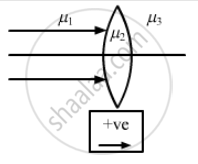
\[\frac{\mu_3 R}{2 \mu_2 - \mu_1 - \mu_3}\]
(b) The light beam is incident on the lens from second medium μ3.
Thus, refraction takes place at second surface.
Using equation of refraction,
\[\frac{\mu_2}{v} - \frac{\mu_3}{u} = \frac{\mu_2 - \mu_3}{R}\]
Where, v is the image distance
Applying sign convention, we get:
\[\frac{\mu_2}{v} - \frac{\mu_3}{\left( - \infty \right)} = \frac{\mu_2 - \mu_3}{R}\]
\[ \Rightarrow \frac{1}{v} = \frac{\mu_2 - \mu_3}{\mu_2 R}\]
\[ \Rightarrow \Rightarrow v = \frac{\mu_2 R}{\mu_2 - \mu_3}\]
Now, refraction takes place at 2nd surface.
Thus,
\[\frac{\mu_1}{v} - \frac{\mu_2}{u} = \frac{\mu_1 - \mu_2}{R}\]
Here, the image distance of the previous case becomes object distance.
\[\frac{\mu_1}{v} = - \left[ \frac{\mu_1 - \mu_2}{R} - \frac{\mu_2}{\mu_2 R}\left( \mu_2 - \mu_3 \right) \right]\]
\[ = - \left[ \frac{\mu_1 - \mu_2 - \mu_2 + \mu_3}{R} \right]\]
\[v = - \left[ \frac{\mu_1 R}{\mu_3 - 2 \mu_2 + \mu_1} \right]\]
Therefore, the image is formed at \[\frac{\mu_1 R}{2 \mu_2 - \mu_1 - \mu_3}\]