Advertisements
Advertisements
प्रश्न
A thin circular ring of radius r is charged uniformly so that its linear charge density becomes λ. Derive an expression for the electric field at a point P at a distance x from it along the axis of the ring. Hence, prove that at large distances (x >> r), the ring behaves as a point charge.
Advertisements
उत्तर १
Let us consider a thin circular ring of radius r with a charge density of λ.
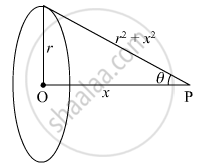
We need to find the electric field due to this charged ring at a point on the axis of the ring at a distance x from its centre.
Let us consider a small charge element (dx) on the ring having a small charge dq.
dq = λ dx
The electric field due to this charge element at the point P is given by:
dE = `1/(4 pi epsilon_0) (dq)/((r^2 + x^2)`
= `1/(4 pi epsilon_0) (lambda dx)/((r^2 + x^2)`
The electric field at the point P will have two components, one in the vertical direction and the other in the horizontal direction.
dE cos θ along the horizontal direction.
dE sin θ along the vertical direction.
The vertical components will cancel out the effect of each other due to the presence of the diametrically opposite element.
So the horizontal component of the electric field will survive at the point P.
From the figure, we have the value of:
cos θ = `x/sqrt(r^2 + x^2)`
Now the integration of the horizontal component dE cos θ will be carried out.
dE cos θ = `(lambdax dx)/(4 pi epsilon_0(r^2 + x^2)3/2`
Since the value of dq = λ dx
dE cos θ = `(x dq)/(4 pi epsilon_0(r^2 + x^2)3/2`
Now, integrating the above equation and taking x and r quantities as constants, we get:
Ex = ∫ dE cos θ
= `int_ (x dx)/(4 pi epsilon_0(r^2 + x^2)3/2`
= `int_ (x dq)/(4 piepsilon_0(r^2 + x^2)3/2)`
= `(x Q)/(4 pi epsilon_0(r^2 + x^2)3/2`
Where Q is the total charge on the ring.
Here, Ex is the value of the total electric field at the point P.
Special case:
When x >> r, the denominator of the above equation gets modified in the following way:
r2 + x2 ≈ x2
Ex = `(x Q)/(4 pi epsilon_0(x^2)3/2)`
= `(x Q)/(4 pi epsilon_0 x^3)`
= `(Q)/(4 pi epsilon_0 x^2)`
So at large distances (x >> r), the ring behaves as a point charge.
उत्तर २
Point P is on the axis of the ring at a distance r from the centre.
The field dE due to a small element dl is considered.
Linear charge density = λ
So, charge of dl element is dq = λ dl
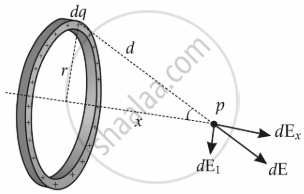
The perpendicular field component for the whole ring will be zero.
So,
dE = `(k dq)/d^2 cos theta`
= `(k dq)/d^2 xx x/d`
= `(k x dq)/((x^2 + r^2)^(3//2))`
E = `int (k x dq)/((x^2 + r^2)^(3//2))`
= `int (k x lambda dl)/((x^2 + r^2)^(3//2))`
= `(k x lambda l)/((x^2 + r^2)^(3//2))`
= `(k x Q)/((x^2 + r^2)^(3//2))`
When x >> r,
E = `(k x Q)/(x^2)^(3//2)`
= `(k Q)/x^2`
This reduces to a simple Coulomb field. In this case, the charged ring looks like a point charge.
