Advertisements
Advertisements
प्रश्न
A stone is thrown vertically upward with an initial velocity of 40 m/s. Taking g = 10 m/s2, find the maximum height reached by the stone. What is the net displacement and the total distance covered by the stone?
Advertisements
उत्तर
Initial velocity (u) = 40m/s
g = −10m/s2
Final velocity at maximum height (v) = 0
Third equation of motion
v2 = u2 + 2gh
0 = 402 + 2 × (−10) × h
1600 = 20h
80m = h
Max Distance = 80m
Total distance travelled by the stone = 80 + 80
= 160m
Because the stone was thrown upwards, but it came back.
Hence, total displacement = 0
संबंधित प्रश्न
A stone is released from the top of a tower of height 19.6 m. Calculate its final velocity just before touching the ground.
An object thrown vertically upwards reaches a height of 500 m. What was its initial velocity? How long will the object take to come back to the earth? Assume g = 10 m/s2.
The value of acceleration due to gravity of earth :
A force of 10 N acts on a body of mass 5 kg. Find the acceleration produced.
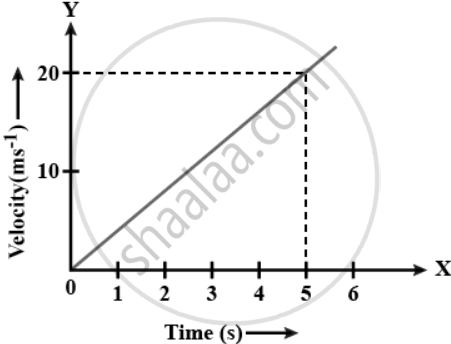
Figure shows the velocity-time graph of a particle of mass 100 g moving in a straight line. Calculate the force acting on the particle.
(Hint : Acceleration = Slope of the v-t graph)
How is the acccelaration due to gravity on the surface of the earth realted to its mass and radius ?
How are g and G realated ?
The free fall of an object is possible only in ______.
Read the given passage carefully and answer the questions.
| We know that the force of gravity due to the earth acts on each and every object. When we were holding the stone in our hand, the stone was experiencing this force, but it was balanced by a force that we were applying on it in the opposite direction. As a result, the stone remained at rest. Once we release the stone from our hands, the only force that acts on it is the gravitational force of the earth and the stone falls down under its influence. Whenever an object moves under the influence of the force of gravity alone, it is said to be falling freely. Thus the released stone is in a free fall. In free fall, the initial velocity of the object is zero and goes on increasing due to the acceleration due to the gravity of the earth. During free fall, the frictional force due to air opposes the motion of the object and a buoyant force also acts on the object. Thus, true free fall is possible only in a vacuum. |
- Complete the following statement by choosing the right option.
The stone held in the hand is stable because on it ......- two unbalanced forces are exerted.
- only the gravitational force of the earth is exerted.
- gravitational force of the earth is not exerted.
- two balanced forces are exerted.
- Why does free fall not happen on the earth?
- Why does the velocity of the object increase during the free fall?
- Which type of force exerts on the object during free fall?
- Why does free fall happen only in a vacuum?
When is free fall possible?
