A spherical metal ball of radius 15 cm carries a charge of 2μC. Calculate the electric field at a distance of 20 cm from the center of the sphere.
Advertisements
प्रश्न
A spherical metal ball of radius 15 cm carries a charge of 2μC. Calculate the electric field at a distance of 20 cm from the center of the sphere.
Advertisements
उत्तर
Given:
R = 15 cm= 15 x 10−2 m
q = 2 µC = 2 x 10⁻⁶ C
To find:
Eat distance (r), where
r = 20 cm = 20 × 10−2 m = 2 × 10⁻¹ m
Formula:
`E = 1/(4 pi epsilon_0) q/r^2`
We know, 1/(4 pi epsilon_0) = 9 xx 10^9
`therefore E = 9 xx 10^9 xx (2 xx 10^-6)/((2 xx 10^-1)^2`
= `9 xx 10^9 xx (2 xx 10^-6)/(4 xx 10^-2)`
= 4.5 × 10⁵ N/C
APPEARS IN
संबंधित प्रश्न
Two charges of magnitudes −4Q and + 2Q are located at points (2a, 0) and (5a, 0) respectively. What is the electric flux due to these charges through a sphere of radius 4a with its centre at the origin?
According to Gauss' theorem, the electric field of an infinitely long straight wire is proportional to ______
Gauss' law helps in ____________.
For a uniformly charged plane sheet, the variation of electric field (E) with distance (d) is correctly shown graphically in graph.
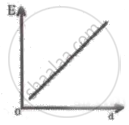
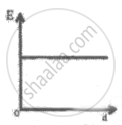
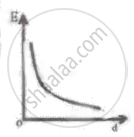
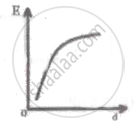
A sphere encloses an electric dipole with charges ± 3 x 10⁻⁶ C. What is the total electric flux across the sphere?
Electric field intensity at a point outside uniformly charged thin infinite plane sheet is 'E1 '. The electric field intensity at a point near and outside the surface of a positively charged conductor of any shape is 'E2'. The relation between magnitude of E1 and E2 is ______.
(assumed air as the medium)
If the radius of the spherical Gaussian surface is increased then the electric flux due to a point charge enclosed by the surface ______
A 2-m long thin and straight metal wire carries a positive charge of 3 µ C. (a) What is the linear charge density on the wire? (b) Hence, find the electric intensity at a point 1.5 m away from the centre of the wire.
What is Gauss's law?
What is a Gaussian surface?
What is the first step in the 5-Step Method to Apply Gauss's Law?
For the chosen surface, how is the flux evaluated when \[\vec E\] is parallel to \[d\vec A\]?
Which equation is applied in the final step to solve for \[E\]?
Which Gaussian surface matches cylindrical symmetry from the symmetry-to-surface map?
For an infinitely long, straight wire, what does \[\lambda\] represent, and what is its SI unit?
What Gaussian surface is used for an infinite line charge?
What charge is enclosed by a coaxial cylinder of length \[l\] around a wire with linear charge density \[\lambda\]?
How does the electric field of an infinite line charge vary with distance \[r\]?
For a uniformly charged thin insulating infinite plane sheet, what does \[\sigma\] represent, and what is its SI unit?
What is the electric field due to a uniformly charged thin insulating infinite plane sheet?
What Gaussian surface is used for a uniformly charged thin spherical shell?
