Advertisements
Advertisements
प्रश्न
A small block of mass m is kept on a bigger block of mass M which is attached to a vertical spring of spring constant k as shown in the figure. The system oscillates vertically. (a) Find the resultant force on the smaller block when it is displaced through a distance x above its equilibrium position. (b) Find the normal force on the smaller block at this position. When is this force smallest in magnitude? (c) What can be the maximum amplitude with which the two blocks may oscillate together?

Advertisements
उत्तर
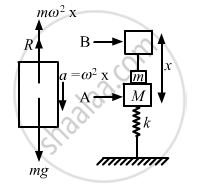
(a) Consider the free body diagram.
Weight of the body, W = mg
Force, F = ma = mω2x
x is the small displacement of mass m.
As normal reaction R is acting vertically in the upward direction, we can write:
R + mω2x − mg = 0 ....(1)
Resultant force = mω2x = mg − R
\[\Rightarrow m \omega^2 x = m\left( \frac{k}{M + m} \right)x\]
\[ = \frac{mkx}{M + m}\]
\[\text { Here }, \]
\[\omega = \sqrt{\left\{ \frac{k}{M + m} \right\}}\]
(b) R = mg − mω2x
\[= mg - m\frac{k}{M + N}x\]
\[ = mg - \frac{mkx}{M + N}\]
It can be seen from the above equations that, for R to be smallest, the value of mω2xshould be maximum which is only possible when the particle is at the highest point.
(c) R = mg − mω2x
As the two blocks oscillate together R becomes greater than zero.
When limiting condition follows,
i.e. R = 0
mg = mω2x
\[x = \frac{mg}{m \omega^2} = \frac{mg \cdot \left( M + m \right)}{mk}\]
Required maximum amplitude
\[= \frac{g\left( M + m \right)}{k}\]
APPEARS IN
संबंधित प्रश्न
A seconds pendulum is suspended in an elevator moving with constant speed in downward direction. The periodic time (T) of that pendulum is _______.
Which of the following example represent (nearly) simple harmonic motion and which represent periodic but not simple harmonic motion?
General vibrations of a polyatomic molecule about its equilibrium position.
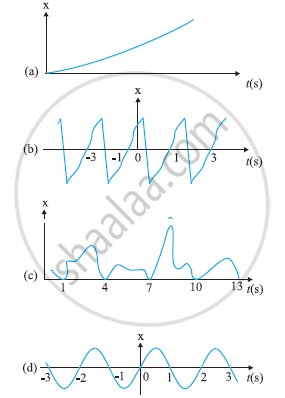
Figure depicts four x-t plots for linear motion of a particle. Which of the plots represent periodic motion? What is the period of motion (in case of periodic motion)?
Answer in brief:
Derive an expression for the period of motion of a simple pendulum. On which factors does it depend?
A particle executes simple harmonic motion with a frequency v. The frequency with which the kinetic energy oscillates is
A particle is fastened at the end of a string and is whirled in a vertical circle with the other end of the string being fixed. The motion of the particle is
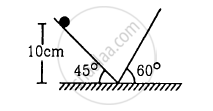
Find the time period of the motion of the particle shown in figure . Neglect the small effect of the bend near the bottom.
The ear-ring of a lady shown in figure has a 3 cm long light suspension wire. (a) Find the time period of small oscillations if the lady is standing on the ground. (b) The lady now sits in a merry-go-round moving at 4 m/s1 in a circle of radius 2 m. Find the time period of small oscillations of the ear-ring.

The period of oscillation of a body of mass m1 suspended from a light spring is T. When a body of mass m2 is tied to the first body and the system is made to oscillate, the period is 2T. Compare the masses m1 and m2
A 20 cm wide thin circular disc of mass 200 g is suspended to rigid support from a thin metallic string. By holding the rim of the disc, the string is twisted through 60° and released. It now performs angular oscillations of period 1 second. Calculate the maximum restoring torque generated in the string under undamped conditions. (π3 ≈ 31)
The maximum speed of a particle executing S.H.M. is 10 m/s and maximum acceleration is 31.4 m/s2. Its periodic time is ______
Which of the following example represent periodic motion?
A freely suspended bar magnet displaced from its N-S direction and released.
Which of the following example represent (nearly) simple harmonic motion and which represent periodic but not simple harmonic motion?
A motion of an oscillating mercury column in a U-tube.
Which of the following example represent (nearly) simple harmonic motion and which represent periodic but not simple harmonic motion?
The motion of a ball bearing inside a smooth curved bowl, when released from a point slightly above the lowermost point.
A simple pendulum of frequency n falls freely under gravity from a certain height from the ground level. Its frequency of oscillation.
Show that the motion of a particle represented by y = sin ωt – cos ωt is simple harmonic with a period of 2π/ω.
A person normally weighing 50 kg stands on a massless platform which oscillates up and down harmonically at a frequency of 2.0 s–1 and an amplitude 5.0 cm. A weighing machine on the platform gives the persons weight against time.
- Will there be any change in weight of the body, during the oscillation?
- If answer to part (a) is yes, what will be the maximum and minimum reading in the machine and at which position?
A particle performs simple harmonic motion with a period of 2 seconds. The time taken by the particle to cover a displacement equal to half of its amplitude from the mean position is `1/a` s. The value of 'a' to the nearest integer is ______.
