Advertisements
Advertisements
प्रश्न
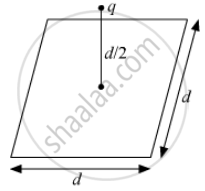
A point charge q is at a distance of d/2 directly above the centre of a square of side d, as shown the figure. Use Gauss' law to obtain the expression for the electric flux through the square.
Advertisements
उत्तर

If we imagine a cube of side d, then this point charge q will be at the centre of the cube.
Now, the total electric flux due to this charge will pass evenly through the six faces of the cube.
So, the electric flux through one face will be equal to 1/6 of the total electric flux due to this charge.
Now, the total electric flux generated by the charge will be given by Gauss's law as :
`triangle phi = vecE.vec(triangleS)` = q/6∈0
So, the electric flux through the square = q/6∈∘">∈∘
APPEARS IN
संबंधित प्रश्न
Explain why, for a charge configuration, the equipotential surface through a point is normal to the electric field at that point
"For any charge configuration, equipotential surface through a point is normal to the electric field." Justify.
If the point charge is now moved to a distance 'd' from the centre of the square and the side of the square is doubled, explain how the electric flux will be affected.
Use Gauss' law to derive the expression for the electric field `(vecE)` due to a straight uniformly charged infinite line of charge density λ C/m.
Through two parallel wires A and B, 10A and 2A of currents are passed respectively in opposite directions. If the wire A is infinitely long and the length of the wire B is 2m, then force on the conductor B, which is situated at 10 cm distance from A, will be:
What is the nature of the Gaussian surface involved in the Gauss law of electrostatics?
Sketch the electric field lines for a uniformly charged hollow cylinder shown in figure.

- Obtain the expression for the electric field intensity due to a uniformly charged spherical shell of radius R at a point distant r from the centre of the shell outside it.
- Draw a graph showing the variation of electric field intensity E with r, for r > R and r < R.
Draw a graph of kinetic energy as a function of linear charge density λ.
