Advertisements
Advertisements
प्रश्न
A person cannot read newspaper placed nearer than 50 cm from his eyes. Name the defect of vision he is suffering from. Draw a ray diagram to illustrate this defect. List its two possible causes. Draw a ray diagram to show how this defect may be corrected using a lens of appropriate focal length.
Advertisements
उत्तर
The person is suffering from Hypermetropia i.e. far-sightedness.
Hypermetropia is caused due to:
(i) The focal length of the eye lens is too long
(ii) Decrease in the length of the eyeball
This defect can be corrected using convex lens of appropriate focal length.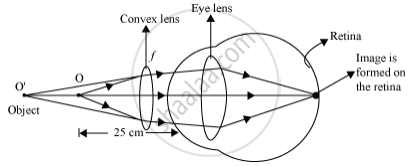
APPEARS IN
संबंधित प्रश्न
Given below is a diagram showing a defect of human eye. Study it and answer the following questions.

(i) Name the defect shown in the figure.
(ii) Give reason for this defect of eye in human being.
(iii) Name the type of lens used to correct the eye defect.
The kind of lens required to correct Myopia
An eye has a near point distance of 0.75 m. What sort of lens in spectacles would be needed to reduce the near point distance to 0.25 m? Also calculate the power of lens required. Is this eye long-sighted or short-sighted?
Differentiate between members of the following pair with reference to what is asked in the bracket.
Rods and cones (sensitivity).
By closing the eyes and gently pressing them by your palms, you may see some specks of brilliant light. How do you get this sensation while there is no light entering your eyes?
Enumerate the common defects of vision, their causes and the possible methods of correcting them.
Give Reason:
Older people require glasses to read and write.
Explain the Term: Astigmatism
Name the following:
Two kinds of accomodations.
Have a look at the posture of this girl who is reading a book and answer the questions which follow:
 |
- Name the problem she is facing.
- What are the two conditions shown in sections A and B of the eye as applicable to her.
- What kind of reading glasses does she need?
 |
 |
| A | B |
