Advertisements
Advertisements
प्रश्न
A particle of charge q is moving with a velocity `vec v` at a distance ‘d’ from a long straight wire carrying a current ‘I’ as shown in figure. At this instant, it is subjected to a uniform electric field `vec E` such that the particle keeps moving undeviated. In terms of unit vectors `hat i`, `hat j` and `hat k`, find -
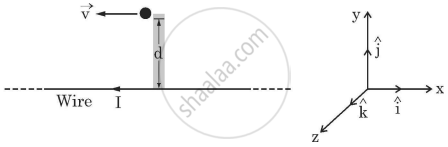
- the magnetic field `vec B`,
- the magnetic force `vec F_m`, and
- the electric field `vec E` acting on the charge.
Advertisements
उत्तर
a. Magnetic field `vec B`:
According to Ampere’s law,
B = `(mu_0I)/(2 pi d)`
The direction is determined by the right-hand rule, and the magnetic field direction is along the negative direction.
`vec B = (mu_0 I)/(2 pi d) hat j`
b. Magnetic force `vec F_m`:
Charge is many along the −x direction,
So, `vec v xx vec B = -(v vec i) xx ((mu_0 I)/(2 pi d) hat j)`
`vec F_B = qv(-(mu_0 I)/(2 pi d) hat k)`
So the direction of the magnetic force is negative.
c. Electric field `vec E`:
The charge is moving undeviated.
`vec F_E + vec F_B` = 0
`vec F_E = q vec E`
⇒ `q vec E = -(-(qvmu_0I)/(2 pi d)hat k)`
`vec E = (v mu_0 I)/(2 pi d)hat k`
