Advertisements
Advertisements
प्रश्न
A particle of mass m and charge (−q) enters the region between the two charged plates initially moving along x-axis with speed vx (like particle 1 in the fig.). The length of plate is L and an uniform electric field E is maintained between the plates. Show that the vertical deflection of the particle at the far edge of the plate is qEL2/(2m`"v"_"x"^2`).
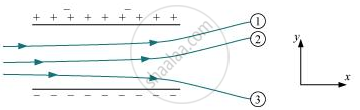
Advertisements
उत्तर
Charge on a particle of mass m = − q
Velocity of the particle = vx
Length of the plates = L
Magnitude of the uniform electric field between the plates = E
Mechanical force, F = Mass (m) × Acceleration (a)
`"a" = "F"/"m"`
However, electric force, F = qE
Therefore, acceleration, `"a" = ("qE")/"m"` ......(1)
Time taken by the particle to cross the field of length L is given by,
t = `"lenght of the plate"/"Velocity of the particle" = "L"/"v"_"x"` .......(2)
In the vertical direction, initial velocity, u = 0
According to the third equation of motion, vertical deflection s of the particle can be obtained as,
`"s" = "ut" + 1/2"at"^2`
`"s" = 0 + 1/2("qE"/"m")("L"/"v"_"x")^2`
`"s" = ("qEL"^2)/(2"m""v"_"x"^2)` ........(3)
Hence, the vertical deflection of the particle at the far edge of the plate is qEL2/(2m`"v"_"x"^2`).
This is similar to the motion of horizontal projectiles under gravity.
संबंधित प्रश्न
Two equal balls with equal positive charge 'q' coulombs are suspended by two insulating strings of equal length. What would be the effect on the force when a plastic sheet is inserted between the two?
Four point charges qA = 2 μC, qB = −5 μC, qC = 2 μC, and qD = −5 μC are located at the corners of a square ABCD of side 10 cm. What is the force on a charge of 1 μC placed at the centre of the square?
Four charges +q, −q, +q and −q are to be arranged respectively at the four corners of a square ABCD of side 'a'.
(a) Find the work required to put together this arrangement.
(b) A charge q0 is brought to the centre of the square, the four charges being held fixed. How much extra work is needed to do this ?
Plot a graph showing the variation of coulomb force (F) versus ,`(1/r^2)` where r is the distance between the two charges of each pair of charges: (1 μC, 2 μC) and (2 μC, − 3 μC). Interpret the graphs obtained.
Find the electric force between two protons separated by a distance of 1 fermi (1 fermi = 10−15 m). The protons in a nucleus remain at a separation of this order.
Two charges 2.0 × 10⁻⁶ C and 1.0 × 10⁻⁶ C are placed at a separation of 10 cm. Where should a third charge be placed, such that it experiences no net force due to these charges?
Four equal charges of 2.0 × 10⁻⁶ C each are fixed at the four corners of a square of side 5 cm. Find the Coulomb's force experienced by one of the charges due to the other three.
Find the speed of the electron in the ground state of a hydrogen atom. The description of ground state is given in the previous problem.
Two charged particles with charge 2.0 × 10⁻⁸ C each are joined by an insulating string of length 1 m and the system is kept on a smooth horizontal table. Find the tension in the string.
Two charged particles, with equal charges of 2.0 × 10⁻⁵ C, are brought from infinity to within a separation of 10 cm. Find the increase in the electric potential energy during the process
Explain in detail Coulomb’s law and its various aspects.
Three charges +Q, q, +Q are placed respectively, at distance, 0, d/2 and d from the origin, on the X-axis. If the net force experienced by +Q, placed at x = 0, is zero then value of q is ____________.
The ratio of the forces between two small spheres with constant charge (a) in air (b) in a medium of dielectric constant K is ______.
For charges q1 and q2 separated by a distance R the magnitude of the electrostatic force is given by ______.
Four equal charges q are placed at the four comers A, B, C, D of a square of length a. The magnitude of the force on the charge at B will be ______.

Two charge – 10c and + 10 c are placed 10 cm apart. Potential at centre of the line joining the two charge is:-
The S.I unit of electric permittivity is
Which of the following statements about nuclear forces is not true?
Two point charges Q each are placed at a distance d apart. A third point charge q is placed at a distance x from the mid-point on the perpendicular bisector. The value of x at which charge q will experience the maximum Coulomb's force is ______.
