Advertisements
Advertisements
प्रश्न
A particle goes in a circle of radius 2.0 cm. A concave mirror of focal length 20 cm is placed with its principal axis passing through the centre of the circle and perpendicular to its plane. The distance between the pole of the mirror and the centre of the circle is 30 cm. Calculate the radius of the circle formed by the image.
Advertisements
उत्तर
Given,
Distance of the circle from the mirror taken as object distance, u = −30 cm,
Focal length of the concave mirror, f = −20 cm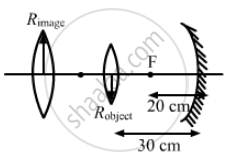
\[\frac{1}{v} + \frac{1}{u} = \frac{1}{f}\]
\[\Rightarrow \frac{1}{v} + \left( - \frac{1}{30} \right) = - \frac{1}{20}\]
\[\Rightarrow \frac{1}{v} = \frac{1}{30} - \frac{1}{20} = \frac{1}{60}\]
⇒ v = \[-\] 60 cm
Therefore, image of the circle is formed at a distance of 60 cm in front of the mirror.
We know magnification (m) is given by:
\[m = - \frac{v}{u} = \frac{R_{image}}{R_{object}}\]
\[\Rightarrow - \frac{( - 60)}{( - 30)} = \frac{R_{image}}{2}\]
Where Robject and Rimage are radius of the object and radius of the image, respectively.
⇒ Rimage = 4 cm
Hence, the required radius of the circle formed by the image is 4 cm.
