Advertisements
Advertisements
प्रश्न
A metallic bucket, open at the top, of height 24 cm is in the form of the frustum of a cone, the radii of whose lower and upper circular ends are 7 cm and 14 cm respectively. Find :
(i) the volume of water which can completely fill the bucket.
(ii) the area of the metal sheet used to make the bucket.
[Use π =\[\frac{22}{7}\]
Advertisements
उत्तर
Upper radius of the bucket (R) = 14 cm
Lower radius of the bucket (r) = 7 cm
Height of the bucket (h) = 24 cm
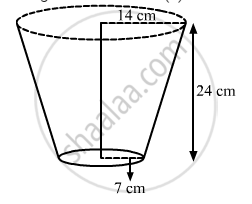
Slant height of the bucket (l) =\[\sqrt{h^2 + (R - r )^2}\]
\[\Rightarrow V = \left\{ \frac{1}{3}\pi\left( {14}^2 + 14 \times 7 + 7^2 \right) \right\}24 {cm}^3 \]
\[ = \left( \frac{1}{3} \times \frac{22}{7} \times 343 \times 24 \right) {cm}^3 \]
\[ = 8624 {cm}^3\]
Thus, the volume of water that can completely fill the bucket is 8624 cm3.
(ii) To measure the area of the metal sheet used in making the bucket, we need to find the surface area of the bucket.
Surface area of the bucket = Curved surface area of the frustum + Curved surface area of the circular base
=\[\pi\left( R + r \right)l + \pi r^2\]
=\[\left( \frac{22}{7} \times \left( 14 + 7 \right) \times 25 + \frac{22}{7} \times 7^2 \right) {cm}^2\]
= \[\left( 1650 + 154 \right) {cm}^2\]
=\[1804 {cm}^2\]
