Advertisements
Advertisements
प्रश्न
A metal cube of edge 12 cm is melted and formed into three smaller cubes. If the edges of the two smaller cubes are 6 cm and 8 cm, find the edge of the third smaller cube.
Advertisements
उत्तर
Volume of large cube `= V_1+V_2+V_3`
Let the edge of the third cube be x cm
`123^3 = 6^3+8^3+x^3`
`1728=216+512+x^3`
⇒`x^3=1728-728=1000`
⇒`x=10cm`
∴Side of third side= 10cm.
APPEARS IN
संबंधित प्रश्न
A matchbox measures 4 cm × 2.5 cm × 1.5 cm. What will be the volume of a packet containing 12 such boxes?
A cuboidal water tank is 6 m long, 5 m wide and 4.5 m deep. How many litres of water can it hold? (1 m3 = 1000l)
The capacity of a cuboidal tank is 50000 litres of water. Find the breadth of the tank, if its length and depth are respectively 2.5 m and 10 m.
Two cubes, each of volume 512 cm3 are joined end to end. Find the surface area of the resulting cuboid.
A box with lid is made of 2 cm thick wood. Its external length, breadth and height are 25 cm, 18 cm and 15 cm respectively. How much cubic cm of a liquid can be placed in it? Also, find the volume of the wood used in it.
A godown measures 40m × 25 m × 10 m. Find the maximum number of wooden crates each measuring 1.5 m
× 1.25 m × 0.5 m that can be stored in the godown.
To make an open fish tank, a glass sheet of 2 mm gauge is used. The outer length, breadth and height of the tank are 60.4 cm, 40.4 cm and 40.2 cm respectively. How much maximum volume of water will be contained in it?
How many small cubes with edge of 20 cm each can be just accommodated in a cubical box of 2 m edge?
A covered wooden box has the inner measures as 115 cm, 75 cm and 35 cm and thickness of wood as 2.5 cm. The volume of the wood is ______.
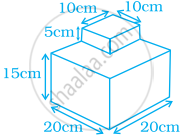
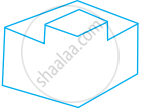
A birthday cake has two tiers as shown in the figure below. Find the volume of the cake.
 |
 |
