Advertisements
Advertisements
प्रश्न
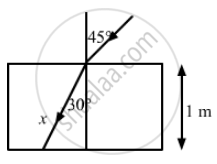
A light ray falling at an angle of 45° with the surface of a clean slab of ice of thickness 1.00 m is refracted into it at an angle of 30°. Calculate the time taken by the light rays to cross the slab. Speed of light in vacuum = 3 × 10⁸ m s−1.
Advertisements
उत्तर
Given,
Angle of incidence, i = 45°
Angle of refraction, r = 30°
Using Snell's law,
\[\frac{\sin i}{\sin r} = \frac{3 \times {10}^8}{v}\]
\[= \frac{\sin 45^\circ}{\sin 30^\circ } = \frac{\left( \frac{1}{\sqrt{2}} \right)}{\left( \frac{1}{2} \right)}\]
\[= \frac{2}{\sqrt{2}} = \sqrt{2}\]
\[So, \]
\[ v = \frac{3 \times {10}^8}{\sqrt{2}} m/s\]
Let x be the distance travelled by light in the slab.
Now,
\[x = \frac{1 m}{\cos 30^\circ} = \frac{2}{\sqrt{3}} m\]
We know:
Time taken
\[= \frac{Distance}{Speed}\]
\[= \frac{2}{\sqrt{3}} \times \frac{\sqrt{2}}{3 \times {10}^8}\]
= 0.54 × 10−8
= 5.4 × 10⁻⁹ s
APPEARS IN
संबंधित प्रश्न
Calculate the distance of an object of height h from a concave mirror of radius of curvature 20 cm, so as to obtain a real image of magnification 2. Find the location of the image also.
Use the mirror equation to show that an object placed between f and 2f of a concave mirror produces a real image beyond 2f.
Use the mirror equation to show that a convex mirror always produces a virtual image independent of the location of the object.
Use the mirror equation to deduce that the virtual image produced by a convex mirror is always diminished in size and is located between the focus and the pole.
An object is kept on the principal axis of a concave mirror of focal length 10 cm. at a distance of 15
cm from its pole. The image formed by the mirror is:
(a) Virtual and magnified
(b) Virtual and diminished
(c) Real and magnified
(d) Real and diminished
Use the mirror equation to show a convex mirror always produces a virtual image independent of the location of the object ?
Can a plane mirror ever form a real image?
The rays of different colours fail to converge at a point after going through a converging lens. This defect is called
Find the maximum angle of refraction when a light ray is refracted from glass (μ = 1.50) to air.
Find the angle of deviation suffered by the light ray shown in figure. The refractive index μ = 1.5 for the prism material.

Write any one use for each of the following mirrors :
(a) Convex
(b) Concave
The figure below shows the positions of a point object O, two lenses, a plane mirror and the final image I which coincides with the object. The focal length of the convex lens is 20 cm. Calculate the focal length of the concave lens.

A point object is placed at a distance of 20 cm from a thin plano-convex lens of focal length 15 cm, if the plane surface is silvered. The image will form at:

The focal length f is related to the radius of curvature r of the spherical convex mirror by ______.
An upright object is placed at a distance of 40 cm in front of a convergent lens of a focal length of 20 cm. A convergent mirror of focal length 10 cm is placed at a distance of 60 cm on the other side of the lens. The position and size of the final image will be ______.
A point object is placed at a distance of 30 cm from a convex mirror of a focal length of 30 cm. What is the separation between the image and the object?
A convex lens of focal length 15 cm is placed coaxially in front of a convex mirror. The lens is 5 cm from the pole of the mirror. When an object is placed on the axis at a distance of 20 cm from the lens, it is found that the image coincides with the object. Calculate the radius of curvature of the mirror - (consider all-optical event):
