Advertisements
Advertisements
प्रश्न
A glass slab is placed over a page on which the word VIBGYOR is printed with each letter in its corresponding colour.
- Will the image of all the letters be in the same place?
- If not, the state which letter will be raised to the maximum. Give a reason for your answer.
Advertisements
उत्तर
- The image of all the letters of the word VIBGYOR in their corresponding colours will not be at the same place.
- The letter of violet colour (i.e. V) appears to be raised maximum, while the letter of red colour (i.e. R) appears to be raised minimum.
Since apparent depth = `"real depth"/"refractive index"` and the refractive index of glass is most for the violet light while least for the red light, therefore the apparent depth is least for violet and most for the red.
APPEARS IN
संबंधित प्रश्न
How is the refractive index of a medium related to the speed of light in it?
How is the angle of emergence related to the angle of incidence when prism is in the position of minimum deviation? Illustrate your answer with help of a labelled diagram using an equilateral prism?
Four students A, B, C and D traced the paths of incident ray and the emergent ray by fixing pins P and Q for incident ray and pins R and S for emergent ray for a ray of light passing through a glass slab.

The correct emergent ray was traced by the student:
(1) A
(2) B
(3) C
(4) D
(i) What is the relation between the refractive index of water with respect to air `("_aμ_\text(w))` and the refractive index of air with respect to water `("_\text(w)μ_ a)` .
(ii) If the refractive index of water with respect to air `("_aμ_\text(w))` is`5/3`. Calculate the refractive index of air with respect to water `("_\text(w)μ_ a)` .
Fill in the blank to complete the following sentence:
When light travels from a rarer to a denser medium, it bends ...........
What is the refractive index of water
The speed of light in air is 3 × 10⁸ ms-1. Calculate the speed of light in water. The refractive index of water is 4/3.
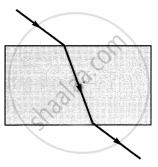
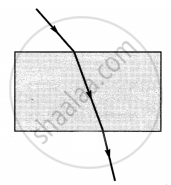
The path of a ray of light coming from air passing through a rectangular glass slab traced by four students are shown as A, B, C and D in the figure. Which one of them is correct?
 |
 |
 |
 |
| A | B | C | D |
A ray of light is incident at an angle of 45° on one face of a rectangular glass slab of thickness 10 cm and refractive index 3/2. Calculate the lateral shift produced ______.
