Advertisements
Advertisements
प्रश्न
A field is in the shape of a trapezium having parallel sides 90 m and 30 m. These sides meet the third side at right angles. The length of the fourth side is 100 m. If it costs Rs 4 to plough 1 m2 of the field, find the total cost of ploughing the field.
Advertisements
उत्तर
Given: In the trapezium ABCD, the two parallel sides are AB = 90 m, CD = 30 m and EC ⊥ AB.
So, EB = AB – EA = 90 m – 30 m = 60 m
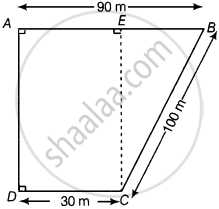
Now, in triangle BEC,
(BC)2 = (BE)2 + (EC)2
1002 = 602 + (EC)2
(EC)2 = 10000 – 3600
(EC)2 = 6400
EC = `sqrt(6400)`
EC = 80 m
Now, area of trapezium ABCD = `1/2` × (Sum of parallel sides) × (Distance between parallel sides)
= `1/2 xx (AB + CD) xx EC`
= `1/2 xx (90 + 30) xx 80`
= `1/2 xx 120 xx 80`
= 4800 m2
The cost of ploughing the field of 1 m2 is Rs. 4.
Now, The cost of ploughing the field of 4800 m2 area = 4800 × Rs. 4 = Rs. 19200.
Therefore, the total cost of plughing the field is Rs. 19200.
APPEARS IN
संबंधित प्रश्न
A triangle has sides 35 cm, 54 cm and 61 cm long. Find its area. Also, find the smallest of its altitudes ?
The adjacent sides of a parallelogram ABCD measure 34 cm and 20 cm, and the diagonal AC measures 42 cm. Find the area of the parallelogram.
Sides of a triangle are cm 45 cm, 39 cm and 42 cm, find its area.
Look at the measures shown in the adjacent figure and find the area of ☐ PQRS.

Find the area of the triangle formed by the points
(1, – 1), (– 4, 6) and (– 3, – 5)
A man walks near a wall, such that the distance between him and the wall is 10 units. Consider the wall to be the Y-axis. The path travelled by the man is
The perimeter of an equilateral triangle is 30 cm. The area is
If the side of a rhombus is 10 cm and one diagonal is 16 cm, the area of the rhombus is 96 cm2.
The cost of levelling the ground in the form of a triangle having the sides 51 m, 37 m and 20 m at the rate of Rs 3 per m2 is Rs 918.
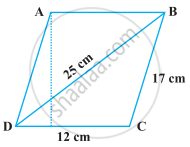
Find the area of a parallelogram given in figure. Also find the length of the altitude from vertex A on the side DC.