Advertisements
Advertisements
प्रश्न
A cylindrical conductor of length l and cross-section area A is connected to a DC source. Under the influence of an electric field set up due to the source, the free electrons begin to drift in the opposite direction of the electric field.
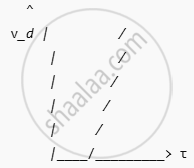
- Draw the curve showing the dependency of drift velocity on relaxation time.
- If the DC source is replaced by a source whose current changes its magnitude with time such that I = I0 sin 2πvt, where v is the frequency of variation of current, then determine the average drift velocity of the free electrons over one complete cycle.
Advertisements
उत्तर
Part 1: Drift Velocity vs Relaxation Time Curve
The drift velocity vdv_dvd of free electrons in a conductor is given by the formula: `v_d = (eEr)/m`
Graph:
Part 2: Time-Varying Current I = I0 sin(2πvt)
The drift velocity is also related to current I by:
`v_d = I/(nAe)`
`I(t) = I_0 sin(2pivt) => v_d(t) = I_0/(nAe) sin (2pivt)`
Average Drift Velocity Over One Cycle:
`barv = 1/T int_o^T v_d(t) dt = 1/T xx I_0/(nAe) int_0^T sin(2pivt) dt`
`int_0^T sin (2pivt) dt = 0`
The average drift velocity over one complete cycle is 0
