Advertisements
Advertisements
प्रश्न
A chord of length 14 cm is at a distance of 6 cm from the centre of a circle. The length of another chord at a distance of 2 cm from the centre of the circle is
पर्याय
12 cm
12 cm
12 cm
18 cm
Advertisements
उत्तर
18 cm
We are given the chord of length 14 cm and perpendicular distance from the centre to the chord is 6 cm. We are asked to find the length of another chord at a distance of 2 cm from the centre.
We have the following figure
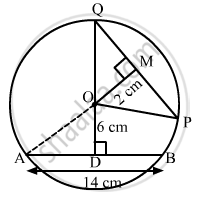
We are given AB = 14 cm, OD = 6 cm, MO = 2 cm, PQ = ?
Since, perpendicular from centre to the chord divide the chord into two equal parts
Therefore
`AQ^2 = AD^2 +OD^2`
= ` 7^2 + 6^2`
= 49 + 36
`= sqrt( 85)`
Now consider the ΔOPQ in which OM = 2 cm
So using Pythagoras Theorem in ΔOPM
`PM^2 = OP^2 -OM^2`
`=(sqrt(85))^2 - 2^2` (∵ OP = AO = radius)
= 81
= 9 cm
Hence PQ = 2 PM
= 2 × 9
= 18 cm
APPEARS IN
संबंधित प्रश्न
A chord of a circle of radius 10 em subtends a right angle at its centre. The length of the chord (in em) is
`(A) 5sqrt 2`
`(B) 10 sqrt2`
`(C)5/sqrt2`
`(D) 10sqrt 3`
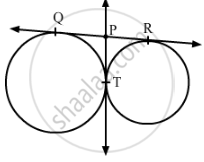
In Fig. 1, QR is a common tangent to the given circles, touching externally at the point T. The tangent at T meets QR at P. If PT = 3.8 cm, then the length of QR (in cm) is :
(A) 3.8
(B) 7.6
(C) 5.7
(D) 1.9
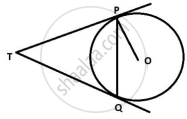
Two tangents TP and TQ are drawn to a circle with centre O from an external point T. Prove that ∠PTQ = 2∠OPQ.
In the given figure, PA and PB are the tangent segments to a circle with centre O. Show that the points A, O, B and P are concyclic.
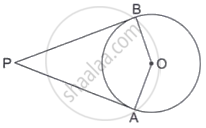
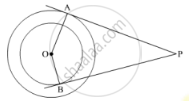
Tangents PA and PB are drawn from an external point P to two concentric circles with centre O and radii 8 cm and 5 cm respectively, as shown in Fig. 3. If AP = 15 cm, then find the length of BP.
Find the length of the chord of a circle in the following when:
Radius is 13 cm and the distance from the centre is 12 cm
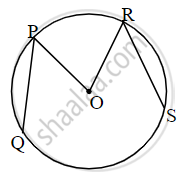
In figure, O is the centre of a circle, chord PQ ≅ chord RS. If ∠POR = 70° and (arc RS) = 80°, find
- m(arc PR)
- m(arc QS)
- m(arc QSR)
If a line segment joining mid-points of two chords of a circle passes through the centre of the circle, prove that the two chords are parallel.
The circumcentre of the triangle ABC is O. Prove that ∠OBC + ∠BAC = 90º.
What is the name for the perimeter of a circle?
