Advertisements
Advertisements
प्रश्न
A boy weighing 40 kgf climbs up a stair of 30 steps each 20 cm high in 4 minutes and a girl weighing 30 kgf does the same in 3 minutes. Compare:
- The work done by them.
- The power developed by them.
Advertisements
उत्तर
(i) Weight of boy = Force = 40 kgf
Distance travelled in climbing 30 steps each
20 cm high = 30 × 20 = 600 cm = 6 m
Work done in 4 min = W = F × S
= 40 × 6 = 240
Weight of girl = Force = 30 kgf
Distance covered in 3 min = 6 m
∴ Work done in 3 min. = F × S
= 30 × 6
= 180 N
∴ Ratio of work done = 240 : 180 = 4 : 3
(ii) Power = `"W"/"T"`
Power developed by
Boy : Girl
⇒ `240/4 : 180/3`
⇒ 60 : 60
⇒ 1 : 1
APPEARS IN
संबंधित प्रश्न
If the power of a motor is 100 kW, at what speed can it raise a load of 50,000 N?
When a body is placed on a table top, it exerts a force equal to its weight downwards on the table top but does not move or fall
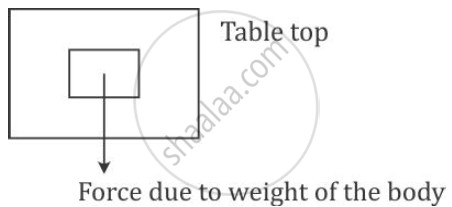
1) Name the force exerted by the table top
2) What is the direction of the force?
Is it possible that no transfer of energy may take place even when a force is applied to a body?
State the principle of moments.
A pump is used to lift 600 kg of water from a depth of 75 m in 10s. Calculate:
- The work done by the pump,
- the power at which the pump works, and
- The power rating of the pump if its efficiency is 40%. (Take g = 10m s-2).
`["Hint" : "Efficiency" = "useful power"/"power input"]`
A bullet fired against a window glass pane makes a hole in it without any cracks while a stone striking the same glass pane smashes it; explain with reason.
A coolie carrying a load on his head and moving on a frictionless horizontal platform does no work. Explain the reason why.
A machine raises a load of 750 N through a height of 16 m in 5 seconds. Calculate the power at which the machine works.
A force of 1 kgf displaces a body by a distance of 10 cm
(i) in direction of force,
(ii) normal to the force
(iii) at an angle of 60° to the direction of the force.
Calculate the amount of work done in each case. (Take: g = 9.8 ms−2 )
